
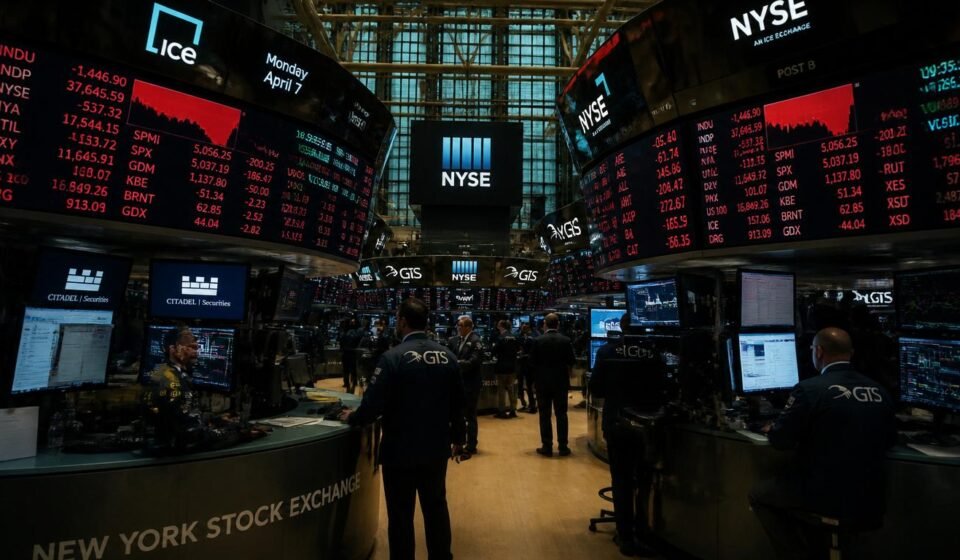
Most days, the stock market moves for reasons that feel vague until you dig into them. Today, June 10, 2026, is not one of those days. The catalysts are clear, and they matter. Three forces are colliding at once: a fresh inflation report, a rapidly escalating military conflict, and growing skepticism around the most expensive trade in markets right now — artificial intelligence.
Understanding why the market is moving on any given day is not about predicting what comes next. It is about reading what the market is actually pricing in. Today, it is pricing in a lot of uncertainty.
The CPI Report: Inflation Is Back Above 4%
The biggest scheduled event of the day dropped at 8:30 a.m. Eastern. The Bureau of Labor Statistics released the Consumer Price Index for May 2026, and it confirmed what many had feared.
The CPI rose 0.5% for the month and 4.2% year-over-year — the highest annual reading since April 2023. Core CPI, which strips out food and energy, rose 0.2% for the month and 2.9% annually. The monthly core reading came in below the 0.3% estimate.
That last detail matters. The headline number was alarming. The core number was a mild relief. Markets held both of those things simultaneously, which is why the reaction was sharp but not catastrophic.
Stock market futures held in negative territory but pulled back from their lows after the CPI release, while Treasury yields held roughly flat.
The bulk of the inflation surge came from a 3.9% monthly jump in energy prices, putting the 12-month energy increase at 23.5%. Core commodities prices actually posted a small decline.
That is the inflation picture in one sentence: energy is driving the number, and everything else is not yet running wild. Whether that distinction holds is the central question hanging over the next several weeks.
What Analysts Are Actually Saying
Wall Street does not speak with one voice on days like today. The range of reactions tells you something important.
Ellen Zentner, chief economic strategist for Morgan Stanley Wealth Management, said the numbers were not as bad as some had feared, but inflation remains well above target. She pointed to higher oil prices, AI-induced inflation, and tariffs as forces that will keep the Fed on the sidelines, adding that the key watch is whether the re-acceleration in the labor market spills into services pricing.
Angelo Kourkafas at Edward Jones said the CPI data gives the Fed some breathing room to remain patient as the energy supply shock plays out, but noted that if oil prices do not moderate, the situation becomes considerably more difficult.
Scott Helfstein at Global X ETFs took a more measured view, arguing that while the headline number moved higher, the pace of price increases was actually slowing, which should help reassure investors and the Fed.
Three respected analysts, three slightly different readings of the same data. That divergence is normal. What all three share is the acknowledgment that the Fed’s next move is genuinely uncertain, and the market hates genuine uncertainty.
The Iran Conflict: Why Oil Is Not Just an Energy Story
The energy spike driving today’s inflation did not come from nowhere.
Iran has been restricting the passage of commercial oil tankers to gain leverage in peace negotiations. As a result, a single barrel of West Texas Intermediate crude is now roughly 62% higher than it was at the start of 2026.
That is an extraordinary move in six months. And it has consequences that go well beyond gas prices.
The United States launched strikes against Iranian air defense sites after an American helicopter was downed in the Middle East, placing severe strain on an already fragile ceasefire. These military actions rattled global markets and pushed investors to move away from risk assets.
A Navy Federal Credit Union economist noted that ending the war in Iran would help moderate inflation, but warned that the worst for food prices may still be ahead.
When oil surges this fast for geopolitical reasons rather than demand reasons, it creates a specific kind of problem. The Fed cannot drill more oil. Raising rates does not resolve a military conflict. So the central bank is being asked to manage an inflation shock that monetary policy cannot fully address.
That situation makes investors nervous in a way that a typical demand-driven inflation cycle does not.
Why the Tech Sector Is Getting Hit Hard
The Nasdaq has taken the sharpest losses, and that is not random.
Major technology and semiconductor shares fell sharply as investors grew nervous about the high costs of artificial intelligence. Companies including Nvidia, Apple, and Advanced Micro Devices saw their stock prices decline. Market observers noted that traders are now demanding clear proof that massive AI investments will generate actual profits.
This is a meaningful shift. For much of 2025 and early 2026, the AI trade ran on optimism and momentum. Valuations were stretched, but rising earnings and accelerating revenue growth gave bulls reasons to hold. That cushion is thinner now.
Super Micro Computer fell 12%, while Old Dominion Freight Line dropped nearly 5% in early trading. On the other side, Robinhood climbed over 8%, KLA Corp. gained 6.7%, and Applied Materials rose 5.5%.
That spread is telling. Selective carnage in AI-adjacent names, while certain semiconductor equipment companies — which benefit from long-cycle capex rather than near-term revenue uncertainty — held up better.
Analysts noted that the recent strong jobs data had already changed market mood before today’s inflation print, elevating the stakes of this CPI report for determining the Fed’s near-term stance on rates.
Higher rates hurt growth stocks disproportionately because they compress the present value of future earnings. When inflation surprises to the upside, the AI trade has nowhere to hide.
H2: Why Is the Stock Market Moving Today? The Fed Is the Real Answer
Every market move this week ultimately circles back to the same place: the Federal Reserve meeting on June 18.
The Fed had cut interest rates six times since September 2024 after bringing the previous inflation spike under control. The expectation at the start of 2026 was that more cuts were coming. That narrative has reversed.
Markets are now fully pricing in a 25 basis point rate hike by the Fed in December 2026.
That is a complete reversal of the rate-cut story that powered much of the 2024 and 2025 rally. When the direction of monetary policy flips from easing to tightening, the entire valuation framework for equities changes. Growth stocks that traded at premium multiples under a rate-cut assumption now look expensive under a rate-hike assumption.
Federal Reserve Chairman Jerome Powell’s forward guidance at the June 18 meeting will be paramount in shaping market expectations for the rest of 2026.
That meeting is now eight days away. Today’s volatility is partly a function of traders repositioning ahead of it.
What Is Actually Holding Up
It is easy to read a down day and conclude that everything is falling. That is not what is happening.
The Roundhill Magnificent Seven ETF slipped just 0.29% in early trading, suggesting mega-cap tech names are holding up better than mid-tier AI companies that carry more risk.
Despite all three major indexes declining, 62.7% of U.S. issues are actually advancing today, reflecting a broadening of the market trade.
Defensive sectors are drawing real money. Energy companies are benefiting directly from higher oil prices. Consumer staples are catching rotation from investors who want dividends and predictable earnings over speculative growth. Financial stocks with rate-sensitive income are also seeing interest, since higher rates eventually benefit bank margins.
This is the market doing what it does in periods of macro uncertainty: rotating, not collapsing.
The Week in Context: How We Got Here
Today did not happen in isolation. The past week set the stage.
Middle East conflict, inflation worries, and a report questioning AI memory costs all contributed to sharp market shifts last week.
On June 9, the Nasdaq and S&P 500 fell largely at the expense of tech and energy stocks as the U.S. prepared fresh kinetic strikes against Iran.
The week before, stocks staged a modest rebound. The Nasdaq climbed 0.86% on Monday, June 8, as semiconductors partially recovered steep losses. But even that recovery was described as not quite getting back on sound footing.
Markets have been in a pattern of partial recoveries followed by renewed sell-offs. Each time, the catalyst is slightly different — sometimes geopolitics, sometimes a Fed signal, sometimes an earnings report that lands poorly. But the underlying anxiety is consistent: inflation is back, and no one is sure how long the Fed will wait before responding forcefully.
What Historically Happens After CPI Surprises
Today’s reaction is worth putting in historical context.
When inflation data surprises to the upside, the immediate market response is usually negative. That is happening now. But the more important question is whether the inflationary force is structural or transitory.
Some analysts argue that extreme lows in consumer sentiment, like those observed in early June 2026, have historically often preceded buying opportunities rather than prolonged deterioration. When pessimism peaks among consumers, it can signal a contrarian moment for investors.
That argument has merit, but it comes with a serious condition. It only applies if the underlying inflation driver eventually resolves. In the current case, that resolution depends heavily on what happens in the Middle East. If the Iran conflict de-escalates and oil retreats, energy inflation cools, core pressures remain contained, and the Fed holds steady. That is a reasonable base case.
If the conflict escalates further and oil pushes above $100 per barrel, the Fed faces a genuinely difficult choice between fighting inflation and protecting growth. That scenario is not priced in yet.
What Individual Investors Should Do With This Information
Understanding why the market is moving is useful. Reacting to daily moves impulsively is not.
A few things are worth being clear-eyed about.
If you own heavily concentrated tech positions purchased at 2024 and 2025 valuations, today is a reasonable moment to reassess your thesis honestly. Not to panic-sell, but to ask: am I holding because the business case is intact, or because selling feels like admitting a mistake?
If you have been sitting on cash waiting for a cleaner entry, understand that a 4.2% CPI print and a military conflict in the Middle East are not unusual historical events. Markets have recovered from worse. The question is your timeline and your capacity to hold through further volatility before a recovery materializes.
If you are in defensive positions — dividend stocks, utilities, consumer staples, short-duration bonds — today’s market is validating that positioning. That is not cause to celebrate, but it is cause to stay the course.
Conclusion
The stock market is down today for three interconnected reasons: inflation just hit a three-year high, a U.S.-Iran military conflict is keeping oil prices elevated and supply chains on edge, and the tech sector is facing growing questions about whether AI valuations are justified at current interest rate levels.
None of these are simple problems. None of them will resolve overnight.
The one piece of genuine relief in today’s data is that core inflation — the part the Fed actually watches most closely — came in below expectations on a monthly basis. That is a thin silver lining, but it is real. It suggests the energy shock has not yet spread deeply into services, wages, and housing.
All eyes turn to the Federal Reserve meeting on June 18. Powell’s tone and guidance will likely determine whether the next significant market move is up or down. Until then, expect the kind of day-to-day volatility that rewards patience and punishes overreaction.
Markets move for reasons. The reasons today are serious but not unprecedented. Staying informed, staying positioned according to your actual goals, and resisting the urge to read daily headlines as permanent truths is how serious investors navigate environments exactly like this one.
FAQ
Why is inflation at 4.2% when the Fed was supposed to have it under control?
The current inflation surge is primarily energy-driven. The Iran conflict pushed oil prices roughly 62% higher since the start of 2026. Energy costs flow quickly into gasoline, transportation, and electricity, which pushes the headline number up fast. Core inflation, which strips out energy and food, is running at 2.9% — uncomfortably above target, but not out of control. The Fed cannot resolve a military conflict with interest rate policy, which is part of what makes this situation difficult.
Will the Fed raise rates at the June 18 meeting?
Most market analysts expect the Fed to hold in June and potentially hike in December if inflation stays elevated. Today’s core CPI reading, which came in below estimates on a monthly basis, gave the Fed some room to wait and watch. Powell is unlikely to move until there is clearer evidence that energy inflation is seeping into broader price categories.
Should I sell my tech stocks right now?
That depends entirely on your time horizon and original thesis. If you bought Nvidia or other AI-related companies for a five-to-ten-year thesis around AI infrastructure growth, one quarter of rate pressure and valuation compression does not invalidate that thesis. If you bought based on momentum and are now holding losses with no clear fundamental rationale, that is a different conversation. Short-term volatility is not a signal to sell quality businesses at depressed prices.
Why is the Nasdaq hit harder than the Dow on days like today?
The Nasdaq is heavily weighted toward growth and technology companies. These stocks are particularly sensitive to interest rate expectations because their valuations depend on discounting future earnings at current rates. When inflation rises and rate hikes become more likely, the present value of those future earnings falls. The Dow, by contrast, is weighted more toward industrials, financials, and consumer staples that are less sensitive to rate changes.
What would make the market recover quickly from this situation?
A credible Iran ceasefire that leads to oil supply normalization would be the fastest catalyst. If WTI crude fell back to the $60 to $70 range, energy inflation would cool quickly, the headline CPI number would drop sharply, and the Fed would have no reason to hike. Markets could recover a significant portion of recent losses within weeks in that scenario. Progress on the geopolitical front is more powerful than any economic data point right now.
Is this the start of a bear market or just a correction?
No one can answer that with certainty. What can be said is that the structural conditions for a sustained bear market — recession, credit stress, collapsing earnings — are not clearly present yet. The labor market is solid, consumer spending is holding up, and corporate earnings remain positive. This looks more like a mid-cycle correction driven by a specific external shock than the beginning of a broad structural decline. That assessment could change if the Iran situation escalates significantly or if core inflation accelerates sharply in the coming months.


[…] […]