
Most people hit their late twenties and start doing the math. They look at their bank account, think about what they imagined for themselves at 22, and feel a gap. Sometimes a big one.
The question of how much you should have saved by 30 is everywhere. Financial magazines give you a number. Social media gives you anxiety. Neither is particularly useful.
What actually matters is understanding what the number means, why it varies so much, and how to think about your own position without comparing yourself to someone in a completely different income bracket or country.
The Standard Benchmark and Why It Is Only a Starting Point
The most commonly cited rule comes from large financial institutions. The general guidance is to have the equivalent of your annual salary saved by age 30.
So if you earn R400,000 a year in South Africa, the target is R400,000 saved. If you earn $60,000 in the US, the target is $60,000. If you earn £35,000 in the UK, that is your benchmark.
This rule has a logic to it. It assumes you started working around 22 or 23, saved consistently, and let compound growth do some of the work. It also assumes your savings rate was roughly 15% to 20% of income across those years.
That assumption is where the rule starts to break down for most people.
Why Most People Are Behind and That Is Not Always Their Fault
Student debt changes the math completely. Someone who graduated with R150,000 or $50,000 in student loans spent their mid-twenties paying that down, not building savings. By 30, they may have zero debt and zero savings. That is actually a reasonable position, not a failure.
Cost of living in major cities has outpaced wage growth in most English-speaking countries for over a decade. A 28-year-old renting in London, Toronto, or Cape Town is paying significantly more for housing than someone the same age in a smaller city. Their ability to save is structurally limited, not a reflection of discipline.
Career path also matters. A teacher or nurse starts at a modest salary and builds slowly. A software developer or finance professional may earn more early but work in expensive cities. Comparing their savings balances at 30 tells you almost nothing meaningful.
The benchmark exists as a directional guide. It is not a verdict on your financial character.
What Your Savings at 30 Are Actually Supposed to Do
This is where most conversations miss the point. People focus on the number without understanding its purpose.
Savings by 30 serve three functions. Emergency buffer, investment foundation, and optionality.
Emergency Buffer
Three to six months of living expenses in accessible, liquid savings is the baseline. This is not investment money. It sits in a money market account or high-interest savings account. It exists so that a job loss, medical bill, or car repair does not put you into debt.
If you have this in place at 30, you are already ahead of a large portion of your age group regardless of what the benchmark says.
Investment Foundation
Beyond the emergency fund, savings at 30 ideally sit in assets that grow. A retirement annuity, pension fund contributions, unit trusts, or a tax-free savings account. The reason the one-year-salary benchmark matters is not the number itself. It is the compound growth that number generates over the next 30 years.
R400,000 invested at 10% annually becomes roughly R6.9 million by age 60. That is the real point of the benchmark. Starting later with less shrinks that outcome significantly.
Optionality
Money at 30 gives you choices. The ability to leave a bad job, move cities, start something, or handle a family crisis without going into debt. This is harder to quantify but very real. Financial cushion at 30 is not just about retirement. It is about having agency over the next decade of decisions.
The Savings Rate Matters More Than the Balance
Here is something most benchmark articles skip. Your savings rate at 30 is more important than your current balance.
Someone with R50,000 saved and a 25% savings rate is in a better position than someone with R200,000 saved and a 5% savings rate. The first person is building momentum. The second is coasting.
A 20% savings rate on a modest income, sustained over time, builds more wealth than a high income with poor savings habits. The math on compound growth rewards consistency far more than lump sums saved irregularly.
If you are at 30 with less than the benchmark but saving aggressively now, you are not behind in any meaningful sense. You are catching up, and the window is still wide open.
Myth One: Renting Means You Are Wasting Money
This belief has cost a lot of people in their late twenties. The idea that renting is throwing money away pushes people into buying property before they are financially ready, often stretching their budget, depleting savings for a deposit, and locking them into a location or a bond they can barely service.
Renting gives you flexibility. It keeps capital liquid. In many markets, renting and investing the difference between rent and a bond repayment actually builds more wealth than ownership in the short term.
Buying property at 28 with a 5% deposit and a stretched bond is not automatically smarter than renting and investing R3,000 a month into a unit trust. The numbers depend entirely on the property, the market, and your personal circumstances.
Owning property by 30 is not a financial milestone. Having a funded emergency account and growing investments is.
Myth Two: A High Salary Means You Are on Track
Income and savings are not the same thing. This distinction seems obvious but it is consistently ignored.
High earners in their twenties often inflate their lifestyle in proportion to their income. Better car, better apartment, more travel. By 30, they have an impressive CV and an empty savings account.
A nurse earning R25,000 a month who saves R5,000 consistently is building more long-term security than a consultant earning R80,000 who saves nothing because expenses always seem to match income.
Lifestyle inflation is the silent destroyer of savings potential. The income you earn in your twenties matters far less than the gap between what you earn and what you spend.
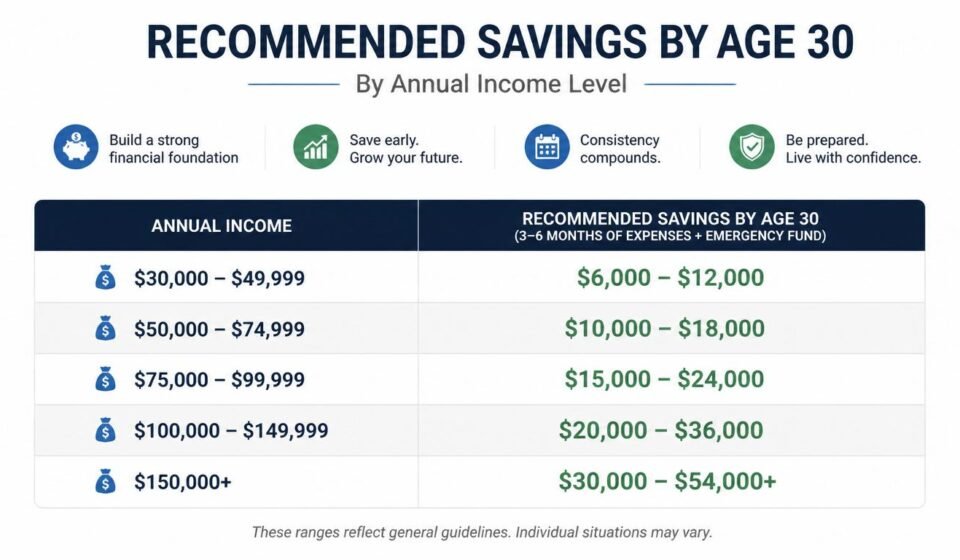
Realistic Savings Targets by Income Level at Age 30
Rather than one universal benchmark, here is a more honest breakdown.
Lower Income Range
If you earned below-average income through your twenties, perhaps R15,000 to R25,000 monthly in South Africa or equivalent in USD or GBP, a realistic target at 30 is three to four months of expenses saved plus whatever you have contributed to a pension or retirement fund through your employer.
This is not failure. This is the reality of building savings on a modest income in expensive times.
Middle Income Range
Earning R30,000 to R60,000 monthly or equivalent, you should realistically have six months of expenses plus R150,000 to R400,000 in retirement or investment accounts by 30, assuming you started saving in your mid-twenties.
If you are below this, the gap is closeable with focused effort over the next three to five years.
Higher Income Range
Above R70,000 monthly or equivalent, the one-year-salary benchmark is entirely achievable and should be the floor, not the ceiling. At this income level, savings below the benchmark usually reflect lifestyle inflation or avoidable debt, not structural limitation.
When Being Behind at 30 Becomes a Real Problem
Being below the benchmark at 30 is common. Staying below it through your thirties without changing behavior is where the long-term damage happens.
The decade between 30 and 40 is arguably the most important for wealth building. Income typically rises. Lifestyle is already established. If you can widen the gap between income and spending in your thirties, the compounding effect by 50 and 60 is dramatic.
Investors and financial planners consistently observe that people who start taking savings seriously at 32 or 35 can still build strong retirement positions. The ones who wait until 45 face a much steeper climb.
The Real Risk
The real problem is not being behind at 30. It is having no plan to close the gap. No budget, no savings rate target, no investment account. That combination of low savings and low awareness is what creates genuine financial difficulty later.
What to Focus on Right Now If You Are Approaching 30
If the number feels uncomfortable, here is a practical priority order.
First, eliminate high-interest debt. Credit cards and personal loans at 18% to 22% interest are destroying your ability to save. No investment reliably beats that cost. Pay it down first.
Second, build the emergency fund. Three months of expenses in a money market account. This is non-negotiable before you invest aggressively.
Third, maximize any employer retirement matching. If your employer matches pension contributions, not capturing that match is leaving guaranteed return on the table. It is the closest thing to free money in personal finance.
Fourth, open a tax-free savings account if you have not already. In South Africa, R36,000 per year grows completely tax-free. In the UK, an ISA works the same way. In the US, a Roth IRA serves this function. These accounts compound faster because tax does not erode the growth.
Fifth, automate everything. Savings that require a manual decision every month get skipped. Set a debit order or automatic transfer on payday and treat it as a fixed expense.
The Comparison Trap
Social media has made financial comparison more damaging than it has ever been. Someone posts about buying their second property at 27. Someone else talks about their investment portfolio at 28. The posts that go viral are the exceptions, not the norm.
The majority of 30-year-olds in South Africa, the US, the UK, and Canada are not sitting on a year’s salary in savings. Many are managing debt, navigating expensive cities, and starting their serious savings journey later than the benchmarks assume.
What matters at 30 is not matching a number pulled from a financial planning formula. It is having a clear picture of your current position, a realistic savings rate, and a plan you will actually follow.
That combination beats a high balance with no direction every time.
Conclusion
The benchmark of one year’s salary saved by 30 is a useful reference point. It is not a universal law and it was not designed with student debt, rising rents, or income inequality in mind.
What the benchmark is really pointing at is habit, consistency, and the power of starting early. If you are at 30 with less than the number suggests, the window to build is still wide open. The people who build real financial security are not always the ones who started with the most. They are the ones who got serious earlier than they had to and stayed consistent longer than felt necessary.
Focus on your savings rate. Eliminate expensive debt. Use tax-advantaged accounts. And stop measuring your financial life against curated social media posts from people whose full circumstances you will never actually see.
Frequently Asked Questions
Is it normal to have no savings at 30? More common than financial media suggests. Student debt, high rent, and stagnant wages in many cities make saving in your twenties genuinely difficult. The priority at 30 is to start building aggressively now rather than focusing on what was not saved before.
Should I invest or save at 30? Both serve different purposes. Keep three to six months of expenses in liquid savings for emergencies. Everything beyond that should be invested, not sitting in a low-interest account losing value to inflation.
Does property count as savings at 30? Equity in property counts as net worth, not liquid savings. It cannot pay an emergency bill or fund a career change without being sold or borrowed against. Do not let home equity substitute for an accessible savings buffer.
What is a good savings rate at 30? Fifteen to twenty percent of take-home income is the standard guidance. If you are behind on savings, pushing toward 25% or 30% for a few years can close the gap faster than you expect.
Is a retirement annuity the same as savings? Retirement annuities and pension funds are long-term investments, not short-term savings. They grow tax-efficiently but cannot be accessed before retirement age without penalties. They should run alongside accessible savings, not instead of them.
What if I am 30 with significant debt and no savings? High-interest debt first, always. Once that is cleared, build a small emergency fund of one month expenses, then split contributions between debt repayment and savings. Doing both simultaneously, even in small amounts, builds the habit and the buffer at the same time.