
The US stock market is worth tens of trillions of dollars. It is the largest equity market in the world. And the ownership of that market is far more concentrated than most people realize.
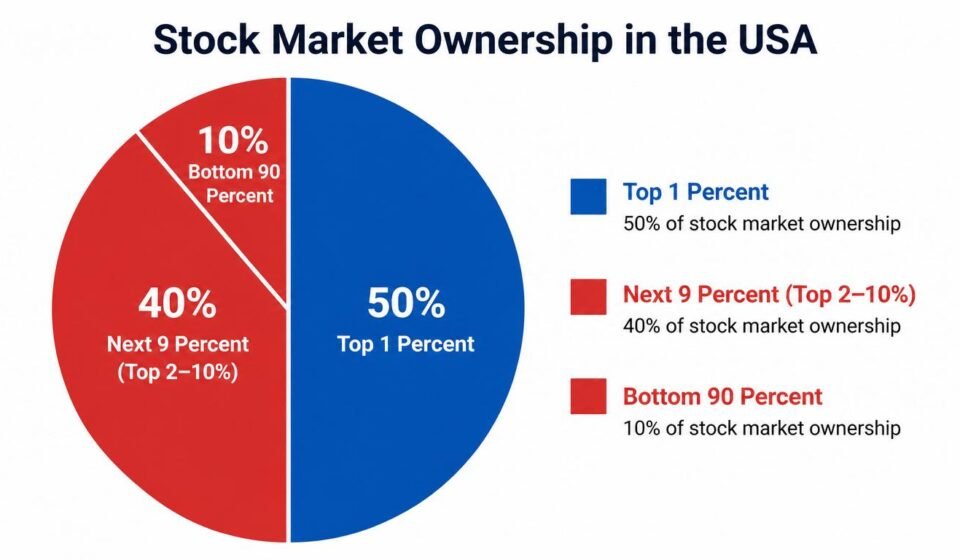
The top 10% of American households own approximately 90% of all stocks. That number has been studied, confirmed, and updated repeatedly by economists and the Federal Reserve. It is not a conspiracy theory. It is a documented feature of how wealth is distributed in the United States.
Understanding who owns the market, and why that concentration exists, tells you a great deal about how wealth compounds, why inequality widens, and what it actually means to participate in the stock market as an ordinary investor.
The Federal Reserve Data Behind the Number
The Federal Reserve publishes detailed wealth distribution data through its Distributional Financial Accounts. The figures are updated regularly and broken down by wealth percentile.
The data consistently shows that the wealthiest 10% of Americans hold the vast majority of corporate equities and mutual fund shares. Within that group, the concentration goes even further. The top 1% alone owns roughly 50% of all stocks.
The bottom 50% of Americans, by wealth, own less than 1% of the stock market in total.
These are not estimates. They come from the same institution that manages US monetary policy and has access to comprehensive financial data across the economy.
The gap has also widened over time. In the early 1990s, the top 10% owned around 80% of stocks. The share has grown since then, driven by rising asset prices, declining stock ownership among middle and lower income households, and the concentration of corporate profits among large companies.
Who Exactly Are the Top 10%
This is where the picture becomes more specific. The top 10% is not a monolithic group. It includes several distinct layers.
Institutional Investors
The largest holders of US equities are not individuals at all. They are institutions. Pension funds, insurance companies, university endowments, sovereign wealth funds, and hedge funds collectively hold enormous positions in the market.
The three largest asset managers in the world, Vanguard, BlackRock, and State Street, collectively manage tens of trillions of dollars. Through their index funds and ETFs, they are the largest shareholders in most major US companies simultaneously.
This is a remarkable and underappreciated fact. Three firms effectively hold significant ownership stakes in nearly every company in the S&P 500. They vote those shares at annual meetings. They engage with corporate management. Their scale gives them influence that no individual investor comes close to matching.
Ultra High Net Worth Individuals
Below the institutional layer sit the genuinely wealthy individuals. Billionaires and centimillionaires who hold concentrated positions in specific companies, often the businesses they founded or led.
Elon Musk’s wealth is largely tied to Tesla and SpaceX equity. Jeff Bezos holds a significant Amazon stake. Mark Zuckerberg controls Meta through a dual-class share structure. These concentrated positions mean that when a single stock rises significantly, one person’s net worth can increase by billions in a single day.
This is the layer most people think of when they imagine stock market ownership. It is real and significant, but it sits within a broader institutional framework.
Affluent Professional Households
The rest of the top 10% includes professionals with substantial retirement accounts, brokerage portfolios, and equity compensation from employers. Doctors, lawyers, senior engineers, executives, and small business owners who have accumulated meaningful investment portfolios over careers.
This group participates in the market through 401k plans, IRAs, index funds, and individual stock holdings. Their ownership is real but diversified and modest compared to the layers above.
Why Ownership Is So Concentrated
Concentration of stock ownership does not happen by accident. Several structural forces drive it.
Stocks Require Surplus Capital
You can only invest what you do not need for immediate expenses. For households living paycheck to paycheck, there is no surplus. According to repeated surveys, a significant portion of American households cannot cover a $400 emergency without borrowing.
When there is no surplus, there is no investment. When there is no investment, there is no participation in market growth. The gap between those who can invest and those who cannot compounds over decades.
Compounding Rewards Those Who Start Early and With More
A household that invests $50,000 at age 30 and earns 8% annually will have roughly $500,000 by age 60. A household that starts with $500 has $5,000 by the same point. The percentage return is identical. The absolute wealth gap is enormous.
Compounding does not reduce inequality. It amplifies the advantage of starting with more capital. This is mathematically neutral but economically significant.
Equity Compensation Flows to High Earners
Stock options, restricted stock units, and equity bonuses are primarily compensation tools for senior employees and executives. A software engineer at a large tech company receives equity as part of their package. A warehouse worker at the same company does not.
This structural feature of corporate compensation means that market gains flow disproportionately to already higher-earning employees, widening the ownership gap within the workforce itself.
Inherited Wealth Includes Stock Portfolios
Intergenerational wealth transfer is a major driver of concentrated ownership. When wealthy individuals die, their portfolios pass to heirs. Those heirs begin their adult financial lives with existing market exposure that most of their peers do not have.
This is not a new observation. But the scale of wealth transfer happening now as the baby boomer generation ages is historically significant. Estimates suggest tens of trillions of dollars will transfer between generations over the next two decades.
The Myth That the Stock Market Represents the Economy
Here is something worth pausing on. The stock market is frequently discussed as if it represents the health of the broader economy or the financial wellbeing of ordinary Americans.
It does neither reliably.
When the S&P 500 rises 20% in a year, the primary beneficiaries are the households that own stocks. The bottom 50% of Americans, who own almost no stocks, experience almost no direct financial benefit from that gain.
This disconnect became visible during 2020. The economy contracted sharply. Unemployment spiked. Small businesses closed in large numbers. And the stock market recovered and then surged to new highs within months.
The market recovered because the Fed cut rates, liquidity flooded the system, and large companies benefited from digital acceleration. None of that directly helped a restaurant owner who closed permanently or a worker whose industry collapsed.
The stock market reflects the value of corporate earnings, not the average standard of living. Conflating the two leads to policy confusion and public misunderstanding.
What Retail Investors Actually Own
The rise of platforms like Robinhood, eToro, and commission-free trading apps has brought millions of new retail investors into the market over the past several years.
This is genuinely positive. More people owning stocks is better than fewer. But the scale of retail ownership relative to institutional and ultra-wealthy ownership is still very small.
Retail investors as a group account for a relatively small percentage of total market ownership. Their trades create noise and occasional volatility. The GameStop episode in 2021 demonstrated that coordinated retail activity could move individual stocks dramatically.
But in aggregate, retail investors do not drive the market. Institutional flows, Federal Reserve policy, corporate buybacks, and earnings expectations move prices far more than individual retail participation.
Owning shares in an S&P 500 index fund is a genuinely useful wealth-building tool for ordinary investors. It is not a path to the kind of wealth concentration that defines the top 1%. The math of starting small and earning average returns does not replicate the outcome of holding a billion-dollar founding stake in a major company.
Corporate Buybacks and Who They Benefit
One mechanism that has significantly amplified stock market concentration is the corporate share buyback.
When a company buys back its own shares, it reduces the number of shares outstanding. Earnings per share rise even if total earnings stay flat. Share prices tend to increase. Existing shareholders benefit directly.
US companies have spent trillions on buybacks over the past decade. This capital could have gone to wages, capital investment, or research. Instead, it returned to shareholders.
Since shareholders are disproportionately wealthy, buybacks function as a wealth transfer mechanism within corporate capitalism. They are legal, common, and heavily debated among economists and policymakers.
This only works in favor of those who already own significant equity. It does nothing for workers without stock compensation and nothing for households without investment accounts.
When Stock Ownership Becomes a Risk Concentration Problem
Ownership concentration creates systemic risks that go beyond inequality.
When a small number of institutional investors hold dominant positions across most major companies, their decisions carry enormous market weight. If large funds shift allocation simultaneously, markets move sharply. Passive index investing, while beneficial for individual investors, creates herding behavior at scale.
There is also a corporate governance concern. If three asset management firms are the largest shareholders of nearly every major US company, their voting behavior on executive pay, climate policy, board composition, and strategic decisions shapes corporate America in ways that are not fully transparent or democratically accountable.
This concentration of financial power is a relatively new feature of modern markets. Its long-term implications for competition, governance, and market stability are still being studied and debated.
What This Means for Individual Investors
If you are an individual investor trying to build wealth, this picture is clarifying rather than discouraging.
The stock market remains one of the most accessible wealth-building tools available to ordinary people. Index funds allow you to own a slice of the entire US economy at very low cost. Compounding works in your favor if you start early and stay consistent.
But the market will not make you wealthy quickly unless you start with significant capital. The concentration of ownership at the top reflects decades of compounding, inherited advantage, equity compensation, and structural access to capital that most households do not have.
Realistic expectations matter. Investing R500 or $100 a month into an index fund is a smart, disciplined habit. Over 30 years it builds meaningful wealth. It does not replicate the trajectory of someone who received stock options worth millions as part of a tech executive compensation package.
Understanding the difference between participating in the market and controlling a meaningful share of it helps you plan your own financial life without chasing outcomes that require a very different starting point.
Conclusion
The top 10% of American households own roughly 90% of the US stock market. Within that group, the top 1% holds around half of all equities. The bottom half of the country owns almost nothing in stocks.
This concentration is driven by surplus capital requirements, compounding dynamics, equity compensation structures, inherited wealth, and the scale of institutional asset management. It has grown over decades and shows no structural sign of reversing.
The stock market is not a reflection of economic wellbeing for ordinary Americans. It is a measure of corporate earnings and asset values, both of which flow primarily to those who already own significant capital.
For individual investors, the lesson is not despair. It is clarity. Participate in the market consistently, use tax-advantaged accounts, keep costs low, and hold for the long term. Build wealth on the terms available to you, not on the terms of people who started from a fundamentally different position.
Markets reward ownership. The earlier and more consistently you own, the more you benefit. That principle applies at every wealth level, even if the outcomes look very different depending on where you start.
Frequently Asked Questions
Does the top 10% owning 90% of stocks mean the market is rigged? Not in a legal sense. The concentration reflects structural advantages like access to capital, equity compensation, and inherited wealth rather than manipulation. The market itself operates on transparent rules. Who benefits most from those rules is a separate and legitimate policy debate.
Can ordinary investors ever close the wealth gap through stocks? Investing consistently over a long period builds real wealth. But replicating the outcomes of those who started with millions or received major equity compensation is not realistic for most households. The goal should be building your own financial security, not matching the trajectory of the top 1%.
Why do the rich keep getting richer through the stock market? Compounding rewards larger starting balances more in absolute terms. Corporate buybacks return capital to existing shareholders. Equity compensation flows to higher earners. And inherited wealth gives the next generation a head start. Each of these reinforces the others over time.
Is investing in index funds still worth it for small investors? Yes, without question. Low-cost index funds give ordinary investors access to broad market returns with minimal fees. The fact that wealthy institutions also use them does not reduce their value for individual investors building long-term wealth.
What role do BlackRock, Vanguard, and State Street play in market concentration? These three firms manage the largest pools of investment capital in the world through passive index funds. They are simultaneously the largest shareholders in most major US companies. Their scale gives them significant but often underexamined influence over corporate governance across the entire economy.
Will stock ownership ever become more broadly distributed? Possibly, if wage growth outpaces inflation enough to create investable surplus for lower income households, or if policy changes like expanded retirement account access or broader equity compensation take hold. Neither trend is currently dominant. Ownership concentration has widened, not narrowed, over the past three decades.