This is one of the most searched questions in South African personal finance. And it makes sense. R10,000 a month is a clean, meaningful number. It covers rent in many cities. It supplements a pension. It gives a retiree breathing room.
But the answer is never simple. It depends on what you invest in, what return you expect, and how long you plan to stay invested.
Let’s break it down properly.
The Math Behind a R10,000 Monthly Target
Before picking any investment, you need to understand the core formula. Monthly income from investments depends on two things: the capital you deploy and the annual yield that capital generates.
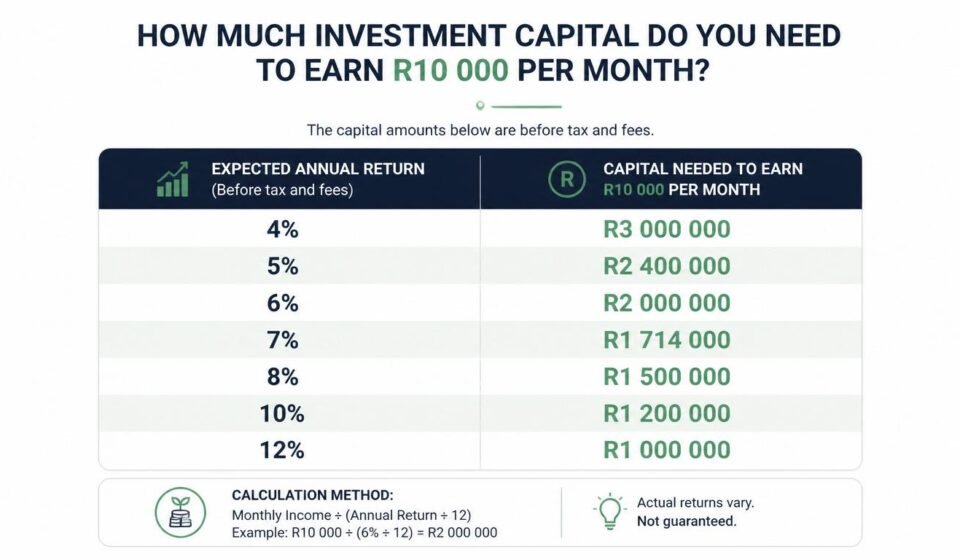
If you earn a 6% annual return, that is 0.5% per month. To get R10,000 monthly from that, you need R2,000,000 in capital.
At 10% annual return, you need R1,200,000.
At 12%, the number drops to R1,000,000.
At 15%, you are looking at around R800,000.
These are pre-tax, pre-fee numbers. The real figures are always higher once you account for tax on interest, capital gains, or dividend withholding tax.
Most investors underestimate how much capital is actually required. They see a high-yield product and assume the income will follow quickly. It rarely works that way.
What Return Rate Is Actually Realistic?
This is where honest advice matters. Many people chase yield without understanding what drives it or what risks come with it.
Low-Risk Returns (4% to 7%)
Fixed deposits, money market funds, and government bonds in South Africa currently sit in this range. These are stable. Capital is relatively protected. But to earn R10,000 monthly, you need roughly R1.7 million to R2.5 million invested.
That is a large sum. Most retail investors cannot get there quickly.
Medium-Risk Returns (8% to 12%)
Dividend-paying stocks, real estate investment trusts (REITs), and balanced unit trust funds often fall here. The income is less predictable month to month. Some months pay more. Others pay less. You also take on market risk.
To earn R10,000 monthly from this range, you need roughly R1 million to R1.5 million in capital.
Higher-Risk Returns (13% to 20%+)
Direct property rental, high-yield equity strategies, or offshore investments in growth markets. These can deliver higher income. But the risk of capital loss, vacancy, or volatility is real.
Chasing 20% yields without deep experience is a fast way to lose capital. I would not recommend building a monthly income strategy on projected returns above 15% unless you have hands-on experience managing that asset class.
The Myth of “Just Invest and Earn Monthly Income”
Here is the first hard truth. Most investment products do not pay monthly. They pay quarterly, biannually, or they accumulate returns that you have to sell to access.
Fixed deposits pay at maturity or at fixed intervals. Unit trusts grow in unit price, not monthly cash. Shares pay dividends, but not every month and not at consistent amounts.
If you genuinely need R10,000 every month, your investment structure has to be specifically designed for that. A general “growth portfolio” will not do it.
This distinction matters because many investors build wealth without building income. You can have R2 million in a well-performing equity fund and still not receive R10,000 a month unless you systematically withdraw.
Systematic withdrawal plans (SWPs) from unit trusts are one solution. But withdrawing from a growth portfolio too aggressively can erode the capital base over time.
Rental Property: The Most Common Path
Property is how most South Africans picture generating R10,000 a month. And it can work. But the numbers need to be right.
Gross Rent vs Net Income
A property generating R14,000 in gross monthly rent does not deliver R14,000 to you. Deduct rates, water and lights in some cases, maintenance reserves, property management fees (typically 8% to 10% of rent), and bond repayments if the property is financed.
After all that, a net yield of 5% to 7% on a well-priced property in South Africa is realistic. Sometimes better in smaller towns or student accommodation. Often worse in oversupplied urban areas.
To clear R10,000 net monthly from property, many investors need two or three properties working together.
The Leverage Question
Buying with a bond means the bank is funding most of the asset. That is useful for building a portfolio. But it also means your net income per property drops significantly in the early years.
A R1.5 million property with a R1.2 million bond at current rates might give you R1,500 to R3,000 in positive cash flow monthly after bond repayments, not R10,000.
Property builds wealth over time through capital appreciation and bond payoff. Monthly income from property alone, in the early years, is usually modest.
The Role of Tax in Your Income Calculation
This section is where most investors make planning errors.
Interest Income
Interest from fixed deposits and money market accounts is taxed as ordinary income in South Africa. If you earn above the interest exemption threshold (currently R23,800 per year for under-65, R34,500 for over-65), everything above that is taxed at your marginal rate.
At a 30% or 36% marginal rate, your effective monthly income drops sharply.
Rental Income
Net rental income is also added to your taxable income. After deducting allowable expenses, you still owe income tax on profit. Many landlords forget to set aside a portion monthly for February’s tax bill.
Dividend Income
Dividends from South African companies are subject to 20% dividends withholding tax, deducted at source. So a R12,500 monthly dividend payment becomes R10,000 after tax.
That is actually one of the cleaner monthly income structures available if you have sufficient capital in dividend-paying shares or listed property funds.
REITs as a Monthly Income Strategy
Listed property funds, or REITs, are worth serious attention for anyone targeting regular income. They are required by law to distribute most of their earnings. Distributions are typically paid twice a year, not monthly. But you can spread positions across multiple funds with different payment schedules to approximate monthly income.
South African REITs have had a difficult few years post-COVID. Many cut distributions. Some recovered. The sector is not without risk.
But for an investor with R1.5 million to R2 million and moderate risk tolerance, a diversified REIT portfolio can realistically target R8,000 to R12,000 in annual distributions per R1 million invested, meaning R13,000 to R20,000 monthly from a R2 million position before withholding tax.
This only works if you select funds with stable underlying property portfolios and manageable debt levels. Chasing the highest distribution yield in REITs without checking loan-to-value ratios is a common mistake.
When the Strategy Fails
Let’s be direct about when income investing breaks down.
When You Start Too Small
If you have R200,000 to invest, targeting R10,000 monthly is not realistic from that base. You are looking at maximum R1,500 to R2,000 monthly in income, depending on what you invest in. Starting with unrealistic income targets leads to taking on too much risk to compensate.
When Interest Rates Drop
Fixed-income strategies are vulnerable to rate cuts. South Africa’s rates have moved significantly over recent years. An investor who locked a strategy around 9% fixed deposit returns may find their income falls when those deposits mature and renew at lower rates.
Building an income portfolio that depends entirely on a single rate environment is fragile.
When Capital Gets Eroded
Withdrawing R10,000 monthly from a R1 million portfolio generating 8% annually means you are withdrawing 12% per year. The portfolio shrinks. Over time, the capital base collapses.
Sustainable withdrawal rates are generally considered to be at or below the portfolio’s annual return. Drawing more than the portfolio earns is a countdown, not a plan.
When Vacancy Hits Property Income
Rental income is not guaranteed. A vacancy of two or three months in a year on a single property can eliminate most of your annual cash flow. Investors who rely on a single property for R10,000 monthly are exposed to this risk every time a tenant leaves.
Diversification across properties or asset classes reduces this. One property is a concentration, not an income strategy.
A Realistic Capital-Building Path
If you do not yet have the capital to generate R10,000 monthly, the focus should shift to accumulation.
The question changes from “how do I earn R10,000 now” to “how do I build R1.5 million in investable assets.”
Contributing R5,000 monthly into a well-diversified unit trust or tax-free savings account (TFSA in South Africa allows R36,000 per year) at a 10% annual growth rate gets you there in roughly 12 to 14 years.
That timeline shortens if contributions increase or returns are higher. It extends if you withdraw early or if markets underperform.
The investors who reach R10,000 monthly income reliably are usually those who spent a decade building capital first and designed their income structure intentionally once the capital was there.
Building a Blended Income Structure
No single asset delivers perfect monthly income. The practical approach is to combine income sources.
A working structure for a R1.5 million capital base might look like this:
R600,000 in a high-yield money market or fixed deposit fund generating stable, liquid interest income. R500,000 in a diversified REIT or dividend fund providing biannual distributions. R400,000 as a deposit on a rental property, with the remaining bond funded through rental income.
Together, this structure might generate R7,000 to R11,000 monthly, depending on market conditions, occupancy, and interest rates. It is not a guaranteed number. It is a range built on realistic assumptions.
Blending also reduces risk. If property income drops, the fixed-income component holds. If rates fall, the equity or REIT portion may compensate.
The Offshore Consideration
South African investors increasingly look at offshore assets for income and capital protection against rand depreciation.
Offshore dividend ETFs or income funds in USD can add a currency benefit. If the rand weakens, your rand-equivalent income rises. But this cuts both ways. A stronger rand shrinks that income.
Offshore investing also adds complexity: exchange control allowances, foreign tax obligations, and platform fees. It is not something to approach without understanding those layers.
That said, for investors with R2 million or more, holding a portion offshore is sensible diversification. Not for higher income necessarily, but for capital preservation.
Conclusion
R10,000 a month is achievable. But it is not cheap and it is not fast.
The capital requirement sits between R1 million and R2 million for most realistic strategies. Tax reduces every income number. No single asset class delivers clean, consistent monthly income without trade-offs.
The investors who reach this goal reliably usually spent years accumulating capital first. They built blended income structures rather than relying on one source. They planned for vacancies, rate changes, and tax. And they stayed realistic about what their capital base could actually produce.
If you are below the capital threshold today, the priority is building it. If you are close, the priority is structuring it correctly before you need the income.
Market conditions change. Returns shift. What holds steady is the discipline to match your income expectations to what your capital can genuinely support.
Frequently Asked Questions
How much capital do I need to earn R10,000 per month from investments? It depends on your return rate. At 6% annually, you need around R2 million. At 10%, roughly R1.2 million. At 12%, around R1 million. Always calculate after tax and fees, not gross returns.
Is rental property the best way to earn R10,000 monthly in South Africa? Property can work, but rarely from a single property in the early years. Net income after bond repayments, maintenance, and management fees is often much lower than expected. Multiple properties or a paid-off property generates cleaner income.
Can I use a tax-free savings account to build toward this goal? Yes, but the annual contribution limit of R36,000 means it takes time. The lifetime limit of R500,000 also caps how much you can shelter. A TFSA works well as part of a broader strategy, not as the entire solution.
What is a safe monthly withdrawal rate from an investment portfolio? Most financial planners use 4% to 5% of portfolio value annually as a sustainable withdrawal rate. Withdrawing more than the portfolio earns will erode capital over time.
Are REITs reliable for monthly income? Most South African REITs pay distributions biannually, not monthly. You can approximate monthly income by holding multiple funds with staggered payment dates. Distribution levels can also fall if the underlying property market weakens, so they are not risk-free.
At what point should I get professional financial advice for income planning? Once you have R500,000 or more in investable assets, or once you are within five years of needing the income, a fee-based financial advisor is worth engaging. The structuring decisions at that level have meaningful tax and sustainability implications.