
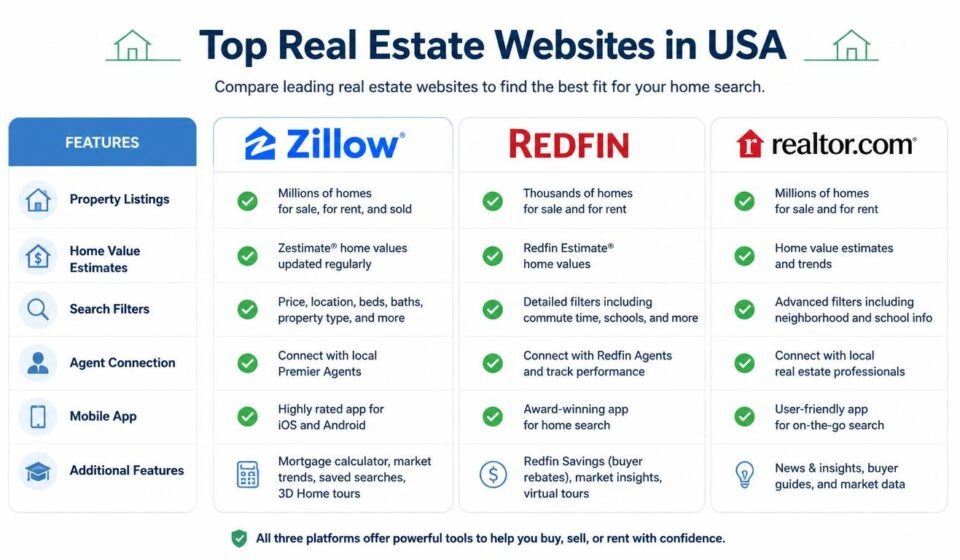
Finding property in the United States used to mean driving neighborhoods, calling agents, and waiting on printed listings. That world is gone. Today, the search starts online, and the platform you use shapes what you see, what you miss, and how quickly you can act.
There are dozens of real estate websites in the US market. Most people default to whatever shows up first in Google. That is not always the best choice. Different platforms serve different needs, and understanding what each one actually does well saves you time and protects you from outdated or incomplete data.
This is a breakdown of the top real estate websites in the USA, what they do better than the competition, and where each one falls short.
Why the Platform You Use Actually Matters
Listing data in the US comes primarily from Multiple Listing Services, known as MLS. These are regional databases maintained by real estate associations. No single national MLS exists. Individual platforms pull from these regional sources and display the data through their own interfaces.
The result is that different websites sometimes show different listings, different prices, and different statuses for the same property. A home marked active on one site may already be under contract on another if the data sync is delayed.
This is not a minor issue in fast markets. In cities like Austin, Phoenix, or Miami where properties move in days, a 24-hour data lag on a platform can mean you are inquiring about a home that is already gone.
Platform choice also affects the quality of tools available to you. Mortgage calculators, neighborhood data, school ratings, walkability scores, and price history vary significantly between sites.
Zillow
Zillow is the most visited real estate website in the United States by a significant margin. It launched in 2006 and built its brand around the Zestimate, its automated property valuation tool.
What Zillow Does Well
The user experience is clean and intuitive. Search filters are detailed. The mobile app is one of the best in the category. Zillow aggregates listings from across the country and covers for-sale homes, rentals, and recently sold properties in one place.
The Zestimate has improved over the years and gives buyers a quick reference point for market value. It is not appraisal-accurate but it is useful as a starting point for research.
Zillow also offers mortgage tools, agent directories, and a 3D home tour feature that became more widely used after 2020.
Where Zillow Falls Short
Listing data is not always current. Zillow does not have direct MLS access in every market, which means some listings appear with delays or remain visible after a sale closes.
The Zestimate is frequently misunderstood. Many buyers treat it as a precise valuation when it can be off by 5% to 10% in markets with limited comparable sales data. In rural areas or unique properties, the margin of error widens further.
Zillow also attempted to enter the iBuying market and exited after significant losses. That episode raised questions about the reliability of its own valuation models in practice.
Realtor.com
Realtor.com is operated by Move Inc and has an official relationship with the National Association of Realtors. That relationship gives it more direct MLS connections than most competing platforms.
What Realtor.com Does Well
Data accuracy and listing freshness are the strongest arguments for using Realtor.com. Because of its MLS connections, listings tend to update faster than on Zillow or other aggregators. In competitive markets, that difference matters.
The site also provides detailed property history, days on market data, and neighborhood information that serious buyers find useful. Agent profiles include verified transaction histories, which helps when evaluating who to work with.
For investors researching market trends, Realtor.com publishes regular housing market reports with data on inventory, price movements, and demand trends by metro area.
Where Realtor.com Falls Short
The user interface feels less polished than Zillow. The mobile experience is functional but not as refined. Some users find the volume of agent contact prompts intrusive when browsing listings.
Rental listings are less comprehensive than dedicated rental platforms. If you are primarily searching for rentals rather than purchases, Realtor.com is not the strongest choice.
Redfin
Redfin operates as both a real estate website and a licensed brokerage. That dual role gives it direct MLS access in markets where it operates and makes it meaningfully different from pure listing aggregators.
What Redfin Does Well
Listing accuracy is Redfin’s clearest advantage. Because it operates as an actual brokerage with MLS membership, its data is among the most current available online. New listings appear quickly. Status changes reflect reality faster than on aggregator platforms.
Redfin also offers a buyer rebate in many markets, returning a portion of the agent commission to the buyer at closing. For a $500,000 purchase, that rebate can be meaningful.
The mapping tools and neighborhood analysis features are well built. Price history, tax records, and walk score data are displayed cleanly alongside listings.
Where Redfin Falls Short
Redfin’s geographic coverage is not universal. It operates its brokerage in major metros but has limited presence in smaller cities and rural markets. Outside its core coverage areas, the listing data relies on the same aggregation methods as competitors.
Some buyers find the agent experience less personalized than working with an independent local agent. Redfin agents handle higher transaction volumes, which can affect attention and responsiveness during a competitive purchase.
Trulia
Trulia is owned by Zillow Group and shares much of its listing data with the parent platform. The two sites often show the same properties.
What Trulia Does Well
Trulia differentiates itself through neighborhood and lifestyle data. Crime maps, commute time calculators, school information, and local amenity data are presented more prominently than on Zillow.
For buyers who prioritize neighborhood research over raw listing volume, Trulia provides a useful layer of context. The community reviews feature, where residents leave comments about their neighborhoods, adds qualitative information that listing data alone cannot provide.
Where Trulia Falls Short
Because it shares data with Zillow, the listing accuracy issues that affect Zillow apply equally to Trulia. The neighborhood data, while useful, is not always current and community reviews can be sparse in less populated areas.
Trulia has not received the same level of product investment as Zillow in recent years. Some features feel dated compared to competing platforms.
Homes.com
Homes.com has been significantly upgraded after CoStar Group, a major commercial real estate data company, acquired and relaunched it as a direct competitor to Zillow and Realtor.com.
What Homes.com Does Well
CoStar’s investment has brought serious data infrastructure to the platform. Listing quality and agent profile information are strong. The site is positioning itself as a more agent-friendly alternative to Zillow, which has had a complicated relationship with the agent community following its iBuying experiment.
For agents and brokers, Homes.com offers advertising and lead generation tools with different economics than Zillow’s model.
Where Homes.com Falls Short
Consumer brand recognition is still catching up to Zillow and Realtor.com. Traffic volumes are lower, which means fewer competing buyers seeing the same listings, which can be an advantage or disadvantage depending on your position.
The platform is still maturing. Some market coverage and feature depth lag behind more established competitors.
Apartments.com
For renters specifically, Apartments.com is the dominant platform in the US market. It is owned by CoStar Group and focuses exclusively on rental listings.
What Apartments.com Does Well
Coverage is broad. The platform lists apartments, houses, condos, and townhomes for rent across the country. Listings include detailed photos, floor plans, virtual tours, and direct contact options for property managers and landlords.
Filtering tools are strong. You can search by pet policy, amenities, lease length, and price with more precision than general real estate platforms offer for rentals.
Where Apartments.com Falls Short
Individual landlord listings are less comprehensive than large apartment complex listings. Private landlords often prefer Craigslist, Facebook Marketplace, or local platforms over paying for Apartments.com placement.
Pricing accuracy for individual units can lag. Advertised rents do not always reflect current availability or negotiated rates.
Zillow Rentals and HotPads
HotPads is another Zillow Group property focused on urban rentals. Combined with Zillow’s own rental search, the network covers a large share of the US rental market.
HotPads works particularly well in dense urban markets where apartment turnover is high and listing speed matters. The map-based search interface suits city renters who are navigating by neighborhood and commute distance.
LoopNet
LoopNet is the leading platform for commercial real estate in the United States. It is also owned by CoStar Group.
For investors looking at office space, retail properties, industrial buildings, or multifamily assets above four units, LoopNet is the primary online destination. Residential platforms do not serve this market adequately.
Commercial real estate investing requires different due diligence than residential. LoopNet provides cap rate data, income and expense information, and broker contact details suited to that process.
This only works well if you understand commercial valuation methods. Browsing LoopNet without understanding net operating income, cap rates, and lease structures leads to poor decisions regardless of how good the platform is.
Land.com and LandWatch
For rural property, agricultural land, hunting land, and timber acreage, mainstream platforms are largely useless. Land.com and LandWatch serve this niche effectively.
Both platforms list rural parcels with acreage details, soil type, water access, and zoning information relevant to land buyers. If you are searching for investment land, farmland, or a rural retreat, these platforms cover inventory that Zillow and Realtor.com largely ignore.
Foreclosure.com and Auction.com
Distressed property investors use specialized platforms rather than mainstream listing sites.
Auction.com handles bank-owned properties, foreclosure auctions, and short sales. Properties are listed with auction dates, opening bids, and property condition disclosures where available.
Foreclosure.com aggregates pre-foreclosure, foreclosure, and bank-owned listings with more detail than general platforms provide.
Both platforms require more due diligence than standard purchases. Many properties cannot be inspected before auction. Title issues are common. These are not platforms for inexperienced buyers.
Which Platform Should You Actually Use
The honest answer is that serious buyers and investors use more than one platform simultaneously.
Start with Redfin or Realtor.com for listing accuracy in active searches. Use Zillow for its breadth and familiarity. Cross-reference both when a property interests you to confirm current status and pricing.
For neighborhood research, Trulia adds a useful layer. For rentals, Apartments.com covers the most ground. For commercial investing, LoopNet is non-negotiable. For rural land, Land.com fills the gap.
No single platform has perfect data, perfect coverage, and perfect tools. Using two or three in combination gives you a more complete picture than relying on any one source.
A Note on Off-Market Properties
The platforms above cover listed properties. A significant portion of real estate transactions in the US happen off-market, particularly at the higher end and in investment circles.
Pocket listings, wholesaler networks, direct mail campaigns, and agent relationships surface properties that never appear on Zillow or Realtor.com. Serious investors who rely exclusively on public listing platforms miss a meaningful segment of the available inventory.
Building relationships with local agents, attending real estate investment association meetings, and networking within specific markets gives access to deals that no website can provide.
Conclusion
The top real estate websites in the USA each serve a specific purpose. Zillow wins on traffic and brand recognition. Realtor.com and Redfin win on data accuracy. Trulia adds neighborhood context. Apartments.com dominates rentals. LoopNet serves commercial investors. Specialized platforms cover land and distressed assets.
The platform that works best depends entirely on what you are trying to accomplish. A first-time homebuyer in a suburban market has different needs than an investor searching for commercial properties or a renter navigating a dense city.
Use the right tool for the right job. Cross-reference data across platforms before acting. And remember that the best deals, in any market, often come from relationships and local knowledge that no algorithm can replicate.
Frequently Asked Questions
Which real estate website has the most accurate listings in the USA? Redfin and Realtor.com generally have more accurate and current listing data than Zillow because of their direct MLS connections. In fast-moving markets, this difference is meaningful.
Is Zillow reliable for home valuations? The Zestimate is a useful starting reference but not a reliable appraisal. It can be off by several percentage points, particularly in markets with limited comparable sales data or unique properties. Always get a professional appraisal before making major financial decisions.
Can I find rental properties on Zillow? Yes, Zillow has a rental search function. However, Apartments.com generally has broader and more detailed rental coverage, particularly for apartment complexes managed by professional property managers.
What is the best website for commercial real estate in the USA? LoopNet is the dominant platform for commercial real estate listings in the United States. It covers office, retail, industrial, and multifamily commercial properties with relevant financial data for investors.
Are there real estate websites that show off-market properties? Some platforms like Propstream and the MLS itself give agents access to off-market and pre-market data. For most consumers, off-market deals come through agent relationships and local investor networks rather than public websites.
Which platform is best for first-time homebuyers? Zillow and Redfin both offer user-friendly experiences suited to first-time buyers. Redfin adds the benefit of a buyer rebate in many markets. Realtor.com is worth using alongside either for data verification on properties of serious interest.