
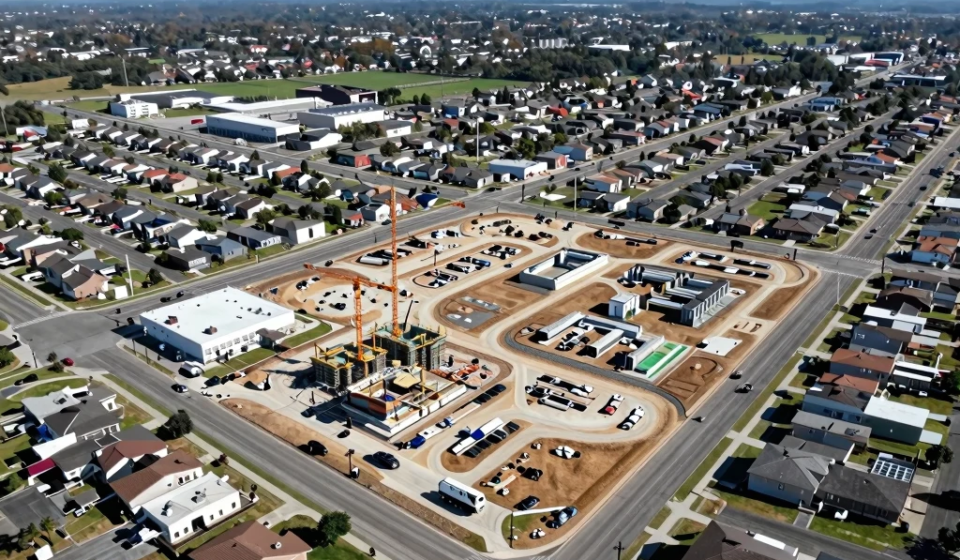
A lot of investors buy the property first and study the neighborhood second. By the time they realize the area isn’t going anywhere, they’ve already signed the mortgage and spent three months on renovations. The neighborhood doesn’t have to be a mystery. It just requires a different kind of due diligence than most people apply.
Assessing a neighborhood for long-term growth isn’t about finding the next hot zip code before anyone else does. That game is mostly luck and timing. What it actually involves is reading a set of layered signals — infrastructure, employment, demographics, policy — and judging whether they’re moving in the same direction. When several indicators align, you have something worth serious consideration. Mixed signals usually mean you should wait. Opposing signals increase risk. Many investors realize this too late.
Why “Up and Coming” Is the Most Dangerous Label in Real Estate
Before getting into the mechanics of assessment, it’s worth challenging the phrase most commonly used to describe neighborhoods with growth potential. “Up and coming” gets applied to areas that have been described that way for fifteen years. It’s often a code phrase for: the infrastructure is decaying, the economics are shaky, but there’s a coffee shop now.
Real neighborhood transformation — the kind that produces sustained price appreciation and rental demand over a decade — doesn’t happen because of aesthetics. It happens when structural fundamentals shift. New transport links. Anchor employers moving in. Genuine population inflows from working-age demographics. Those things take years to materialize, and the early signals are usually boring.
This is where most investors get it wrong. They read lifestyle signals — new restaurants, a mural, a gym — and conclude that capital appreciation is around the corner. Lifestyle signals can be genuine precursors to change, but they can also be gentrification window dressing in a neighborhood that will revert once the subsidy or the novelty runs out. The question isn’t what the neighborhood looks like today. It’s what the structural drivers are, and whether they’re durable.
Infrastructure Investment as a Leading Indicator
The single most reliable long-term growth signal in any neighborhood is committed public infrastructure spending. Not announced. Not proposed. Committed — meaning funded, contracted, and under construction or recently completed.
A new transit line changes the effective commute radius for an entire district.That’s not an opinion—it’s documented in property data across major rail expansions in the United Kingdom, Canada, and the United States over the past 30 years. Areas within walking distance of new transit stops have consistently outperformed nearby neighborhoods in both price growth and rental demand. The key caveat is timing. Prices often rise before the line opens, so buying after the announcement can mean purchasing at the peak of speculative uplift.
Road improvements, broadband infrastructure upgrades, and flood defense spending can all serve similar functions. They reduce the cost of accessing or occupying an area. They signal that local and federal government has prioritized the area enough to fund it. That political signal matters because it tends to continue — investment begets investment, partly for practical reasons and partly for political ones.
What to do in practice: check local government planning portals for infrastructure plans over the next five to ten years. In the US, the Federal Highway Administration and local DOT websites publish project pipelines. Regional investment data in the UK comes from the National Infrastructure Commission. In Canada, federal commitments are tracked by Infrastructure Canada. These are primary sources, not news articles. News articles speculate. Published funding allocations are considerably more reliable.
School performance is a specific form of infrastructure signal. In residential property markets, school catchment areas function almost like a second price variable. Neighborhoods with improving school ratings — not just good ones, but improving ones — tend to attract owner-occupiers with families, who are among the most stable and long-term residents a neighborhood can have. The ripple effect on price stability and rental demand is substantial and persistent.
Reading the Employment Base Without Getting Fooled
The economic base of a neighborhood — or more accurately, the wider local economy it sits within — is the most important long-term driver of property values. Everything else is secondary. If the jobs leave, or if there was only one employer to begin with, no amount of infrastructure investment or demographic churn will produce sustained growth.
The critical variable here isn’t the number of jobs. It’s the diversity and resilience of the employer base. A neighborhood adjacent to a single large employer — an auto plant, a military base, a university — is not a growth investment. It’s a concentrated bet on that employer’s continued presence. These areas can look excellent for years and then collapse in a single cycle when the employer downsizes, relocates, or becomes obsolete. There are dozens of mid-sized American cities that have experienced exactly this pattern over the past four decades.
What you want to see is a mix of employer types, preferably with some representation in sectors that have structural tailwinds: healthcare, technology, logistics, professional services, and education. Not because any of those sectors is immune to downturns, but because diversification reduces single-point failure risk the same way it does in a financial portfolio.
Income growth data is a more precise indicator than employment numbers. A neighborhood adding jobs in the $35,000 to $45,000 range is structurally different from one adding jobs in the $70,000 to $90,000 range, even if the headline employment figure looks similar. Higher-income job growth supports higher rents, higher purchase prices, and — critically — lower vacancy rates and more stable tenants. US Census Bureau tract-level income data, Statistics Canada, and the UK’s ONS local area economic data all provide this breakdown if you’re willing to look for it.
Here is a shorter, tighter version:
Another observation: e-commerce logistics now drives jobs in many suburban and exurban areas. These places once had weak economic bases. Warehouse and distribution work is usually stable and pays above minimum wage. It also needs fewer amenities than office jobs. Over the past decade, several suburban markets in the southeastern US and the English Midlands have grown because of logistics expansion. It isn’t glamorous. That’s why many investors overlook it.
Demand Signals That Actually Matter
Population flow is the clearest demand signal available, and it’s one of the most underused. Net migration into a census tract or local authority area — specifically of working-age adults — tells you more about future rental demand than any other single variable. People follow jobs. They also follow affordability. Both are worth tracking.
Permit data is a proxy signal for developer confidence. When builders keep pulling permits in a neighborhood, it signals confidence. A steady pattern over several years matters. It shows professional investors have run the numbers and see potential. Developers aren’t always right. But they have better access to local planning data than most individuals. They also don’t speculate casually.
The owner-occupier percentage in a neighborhood is a stability signal. Areas with 60% or more owner-occupiers tend to have more consistent maintenance, lower crime, more stable school populations, and more organized political advocacy for local investment. They also tend to appreciate more steadily, if less dramatically, than predominantly rental neighborhoods. For a buy-and-hold investor, that stability has real cash value.
Days-on-market data is the most immediate demand signal. If properties in a neighborhood consistently sell in under three weeks, that reflects genuine competitive demand, not just a low asking price. Comparing this metric year-over-year shows trajectory. A neighborhood moving from 60-day average sales to 28-day average sales over three years is telling you something real, provided the sales volume is sufficient to make the average meaningful.
When the Growth Story Fails: Common Scenarios
This is the section most positive-framing real estate content skips over. The growth assessment frameworks described above can all generate false positives. Here’s when they do.
The single-catalyst neighborhood. An area gets one transformative anchor — a stadium, a university campus extension, a government office relocation — and prices run ahead of fundamentals before the second and third wave of economic development ever materializes. The catalyst stalls. Developer demand fades. Early buyers end up holding properties that rose for 18 months and then stayed flat for a decade. This happens more often than case studies suggest. Flat periods rarely get written up.
The infrastructure lag. Transit investment is announced, prices move, and then the project takes twelve years to complete instead of six. During that window, the neighborhood fundamentals don’t actually improve. But much of the expected appreciation gets priced in early. This pattern shows up repeatedly in major North American and United Kingdom cities. It creates a structural risk when you buy on announced infrastructure instead of delivered projects.
The demographic misjudgment.Young professional inflows often signal growth, but they can reverse quickly. This happens when affordability falls faster than income growth. It also happens when local jobs shift. Several US urban neighborhoods gentrified in the 2010s saw reversals later. Remote work changed commute patterns. Rising costs also pushed younger residents further out.
I wouldn’t buy in a neighborhood where the growth thesis rests on a single catalyst unless the purchase price reflects genuine distress rather than speculative optimism. The margin for error in single-catalyst stories is too thin for long-term holding strategies.
What Local Policy Exposure Actually Means for Investors
This gets less attention than it deserves. Zoning policy, rent control legislation, and property tax structures can fundamentally alter the economics of a neighborhood investment regardless of how strong the underlying demand and infrastructure signals are.
Cities that have expanded rent stabilization frameworks — several major Canadian cities, a growing number of US municipalities, and parts of the UK under selective licensing regimes — have created meaningful divergence between markets that look similar on the surface. A neighborhood with strong rental demand and good infrastructure scores can still deliver weak investor returns if local regulation compresses the rent-to-cost ratio or increases compliance costs substantially.
The inverse is also worth tracking. Areas where zoning reform is making it easier to build — allowing more density, reducing parking minimums, streamlining approvals — tend to see higher construction activity, which increases housing supply but also signals that the local political environment is broadly pro-development. That environment tends to be more investor-friendly over time, even if it means more competition.
The Practical Sequence for Neighborhood Assessment
When I’m working through a neighborhood, the sequence looks roughly like this: start with employment data at the county or local authority level, then drop down to census-tract income trends, then check planning portals for infrastructure commitments, then pull permit data for the last three to five years, then look at days-on-market trend and owner-occupier percentage. That takes several hours across three to five data sources. Most of it is publicly available for free.
What I’m trying to answer by the end of that process is: are at least three of the major signal categories pointing in the same direction? One strong signal is interesting. Two converging signals are worth investigating further. Three or more aligned signals — strong employment base, infrastructure investment, positive population flow, active permit environment — are about as close to a durable growth case as neighborhood-level analysis can provide.
If the signals are mixed or contradictory, that’s not necessarily a reason to walk away. It’s a reason to wait, to watch how the contradictions resolve, and to revisit in six to twelve months. Patience is a legitimate investment strategy in neighborhood selection. Buying into an unclear situation at a high price because the narrative sounds compelling is not.
What to Check Before You Commit
Before making a final decision on any neighborhood, verify the following independently: the infrastructure spending is actually committed and funded, not just announced; the employer base includes at least three to four distinct sectors with no single employer representing more than 25% of local employment; census-level income data shows a positive trend over at least five years, not just one or two; and local planning policy isn’t moving in a direction that would structurally impair investor returns over your holding period.
Avoid neighborhoods where the investment case depends on one catalyst materializing on schedule. Avoid areas where the growth narrative is primarily driven by aesthetic change rather than economic fundamentals. And be cautious about any neighborhood that’s described universally as “about to turn” — if the consensus already expects a turnaround, the price usually already reflects it.
The next step for most investors is actually spending time in the neighborhoods they’re considering — walking them at different times of day, talking to local business owners, visiting the schools and transport links in person. Data can tell you a great deal, but the texture of a neighborhood’s direction is something you develop a feel for through direct observation. Data narrows the field. Judgment closes the decision.
Frequently Asked Questions
How long does it typically take for infrastructure investment to show up in property values? It varies considerably by project type and market. Transit investments tend to produce the earliest price movement — often beginning at announcement, with a second wave at completion. Road and utility improvements typically have a longer lag, often three to five years before measurable price effects. School improvement impacts tend to build gradually over five to ten years as the catchment area’s reputation shifts.
Is it better to buy before or after neighborhood gentrification begins? The honest answer is that buying before significant gentrification is visible requires accepting more uncertainty and a longer holding horizon. Buying after it’s underway reduces that uncertainty but reduces the upside significantly. The sweet spot most experienced investors target is early-middle: when two or three structural signals are clearly positive, but before the area appears in mainstream investment publications. At that stage, the risk-adjusted return tends to be more attractive.
How do you assess a neighborhood in a market you don’t know well? Start with publicly available data: census income trends, permit data, local planning portals, and school performance ratings. Then supplement with ground-level research: local newspapers, community Facebook groups, and conversations with local agents who specialize in the area rather than regional generalists. Local agents with deep market knowledge in a specific neighborhood are often the most underused research resource in property investment.
Does a high crime rate automatically disqualify a neighborhood for investment? Not automatically, but the trajectory matters more than the current level. A neighborhood with a high crime rate that has declined 25% over five years is structurally different from one with a moderate crime rate that’s been rising. Declining crime tends to correlate with improving economic conditions and increasing owner-occupier density. Rising crime in an otherwise seemingly improving neighborhood is a signal worth taking seriously as a counterindicator.
Can a neighborhood have strong fundamentals but still be a poor investment? Yes, if you pay too much. Strong fundamentals that are already fully priced in by the market produce average returns at best and capital losses at worst if conditions shift. Neighborhood quality is only one half of the investment equation. Entry price relative to income yield and comparable sales determines whether strong fundamentals translate into a strong return.
How useful are automated valuation models and online neighborhood scores? They’re useful as screening tools to narrow a large field of options, but they should not drive final decisions. Most automated models lag real-world market conditions by six to twelve months, and neighborhood scoring systems tend to over-weight historical crime data and under-weight forward-looking economic indicators. Use them as a starting point, not a conclusion.


[…] the expected monthly rent and multiply by twelve. If the property rents for $1,500 per month, annual income is $18,000. This sounds simple, but it is where many […]
[…] Assess Neighborhoods for Long-Term Growth […]