
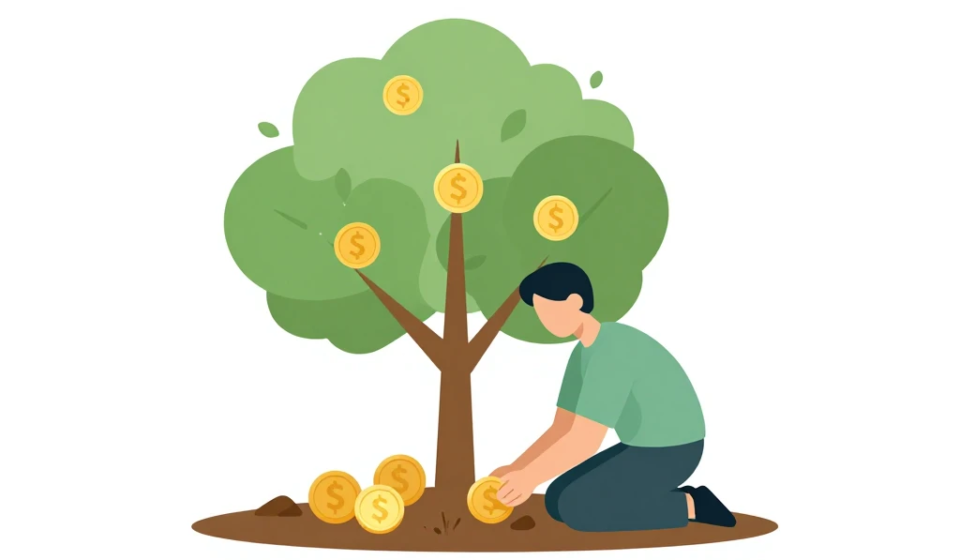
Most people understand compounding in the abstract. Fewer actually build their financial decisions around it. That gap — between knowing something and acting on it consistently — is where most wealth-building plans quietly fall apart.
Two investors, same $10,000, same 7% return, same 30 years. One earns simple interest. The other reinvests everything. The difference at the end exceeds $45,000, and neither investor had to do anything differently after year one. That is not a trick. That is the actual math, and it plays out the same way every time the conditions are met.
The uncomfortable truth is that compounding is not a strategy most people are actually executing. They understand the concept when it is explained. Agreement often follows quickly, at least at an intellectual level. Yet their financial decisions frequently fail to reflect that understanding. Over time, these small inconsistencies quietly erode the benefits of compounding.
Understanding why that happens — and what to do differently — matters more than memorizing the formula.
What Compounding Really Means for Everyday Investors
The textbook definition — earning returns on your returns — makes compounding sound passive and inevitable. In practice, it is neither of those things.
Compounding works only when money stays invested, returns are always reinvested, and time passes without interruption. If any one of these conditions breaks, growth slows. If more than one breaks, the curve flattens. Without all three, compounding loses its power.
This is where most investors get it wrong. They treat compounding as a background process that runs automatically while they make other decisions. It does not work that way. Each withdrawal shrinks the base that could have compounded further. Panic-driven selling during downturns tends to lock in losses that would otherwise have recovered. Even time spent in low-yield savings quietly slows the overall momentum of growth.
Each decision weakens the compounding engine. The lost time and growth cannot be fully recovered later.
A 3% return compounded over 30 years turns $10,000 into roughly $24,000. A 7% return over the same period turns it into $76,000. A 10% return produces approximately $174,000 from that same starting point. The difference between 3% and 10% feels small in the first year. It is only a $700 gap on a $10,000 investment. Over decades the gap becomes enormous. By year thirty it can reach around $150,000. The rate of return matters more than most investors expect. Early years are especially powerful because each percentage point has decades to compound.
Why Time Is the Most Valuable Input in the Compounding Equation
Starting at 25 versus 35 does not sound like a catastrophic difference when you are young and retirement feels distant. With compounding, however, a 10-year head start can be worth more than doubling your total lifetime contributions.
Consider two investors with identical goals and identical investment vehicles. The first investor saves $5,000 each year from age 25 to 35 and then stops contributing while the money stays invested. The second investor starts at age 35 and saves $5,000 each year until age 65, investing for thirty years and contributing three times more money.
With a steady 7% annual return, the first investor often finishes with a larger portfolio. Starting early gives compounding far more time to work.
That scenario is worth examining critically rather than simply accepting at face value. The math works cleanly under ideal conditions: consistent returns, no withdrawals, no tax drag, no major disruptions. Real life introduces complications that the model ignores. But the directional point is valid and important. Time in the market compounds in ways that extra money contributed later cannot fully compensate for.
This is especially true when late contributions also have less time to grow. The practical implication is uncomfortable for people who have delayed investing. Every year of hesitation carries a compounding cost that never appears on a statement but is absolutely real. A 28-year-old who spends two years researching funds is losing valuable time. Waiting for the “perfect” entry point also delays compounding. Market timing debates add no guaranteed benefit. The cost accumulates silently each month. Time in the market keeps slipping away.
Starting imperfectly is almost always better than waiting to start correctly.
The Accounts Where Compounding Works Most Efficiently
Not all compounding environments are equal. The vehicle used for investing matters almost as much as the return itself. Taxes can reduce gains before they are reinvested. This weakens the effect of compounding over time. Choosing tax-efficient structures helps preserve growth.
In a standard taxable brokerage account, dividends and capital gains distributions trigger annual taxes. That annual tax event reduces the base that compounds in the following year. Over 30 years, the cumulative effect of that annual drag becomes significant. It creates a meaningful gap in final portfolio value. Many investors overlook this impact. They focus on gross returns instead of after-tax results. The difference compounds quietly over time.
Tax-advantaged accounts are specifically structured to let compounding run without that annual interruption. In the United States, Roth IRAs use after-tax contributions that grow tax-free, and qualified withdrawals in retirement are also tax-free. Traditional IRAs and 401(k)s defer taxes until retirement, allowing the full pre-tax amount to compound in the meantime. In the United Kingdom, the Individual Savings Account provides a tax-free wrapper for both growth and withdrawals. In Canada, the Tax-Free Savings Account works like a Roth structure. Contributions are made after tax, and growth is tax-free. The Registered Retirement Savings Plan works like a traditional account. Contributions are tax-deductible, and taxes are paid at withdrawal.
The Roth IRA deserves particular attention for younger investors who are currently in lower tax brackets. Because a Roth-style account taxes contributions upfront, every dollar of growth compounds without future taxation. The gains on those gains also remain untaxed. Over decades, this creates a powerful compounding effect. Someone starting in their 20s can let the account grow for 40 years. The tax-free final balance can represent a large share of total wealth.
This doesn’t mean people should prioritize optimizing account type over simply starting to invest. For those who are significantly behind, time in the market usually matters more than choosing the perfect tax-advantaged vehicle. The right account still matters, but investing today in any available account beats waiting to invest later in an ideal one.
How Compounding Functions Across Different Asset Classes
Compounding is not exclusive to stock markets. However, not every asset compounds in the same way, and some popular alternatives do not really compound at all in the true mathematical sense.
Dividend reinvestment in equities represents compounding in its most direct form. When investors reinvest dividends from stocks or funds, they use those payouts to buy additional shares. Those new shares then generate their own dividends in future periods, increasing the total share count without requiring extra capital. The risk emerges when companies reduce or eliminate dividends during financial stress, which breaks the reinvestment cycle just as many investors also feel pressure to sell.
Index funds and ETFs provide broad market exposure with compounding occurring through both price appreciation and reinvested distributions. The low fee structures of most passive index products mean that a greater portion of each year’s return is retained and allowed to compound forward. This is not a trivial advantage. A 1% annual management fee reduces the compounding base by that amount every single year. On a $200,000 portfolio earning 7% gross over 25 years, the difference between a 0.1% fee and a 1% fee in final portfolio value exceeds $150,000. Fees compound in reverse, working against the investor with the same mathematical force that returns work for them.
Real estate can build wealth through compounding, but the mechanism is less clean than equity investing. Appreciation is not guaranteed and varies significantly by location, economic cycle, and property type. In real estate, compounding typically comes from a mix of price appreciation, reinvested rental income, and equity growth through mortgage amortization over time. It is messier, more capital-intensive, and far less liquid than equity compounding. Comparing property returns to index fund returns without accounting for maintenance costs, vacancy periods, financing expenses, property taxes, and management time almost always flatters real estate unfairly.
Bonds and fixed income instruments compound cleanly when investors reinvest coupon payments, allowing those payouts to generate additional interest over time. However, their lower expected returns compared to equities generally produce a shallower growth curve over long horizons. The post-2022 interest rate environment made short-duration government bonds and high-quality corporate bonds genuinely useful again for the fixed income portion of a portfolio, particularly for investors approaching retirement who are reducing equity exposure. The compounding still occurs — it simply occurs more slowly.
High-yield savings accounts and money market funds technically compound, but at rates that historically have struggled to match inflation over long periods. These vehicles serve an important purpose for emergency funds, short-term goals, and capital awaiting deployment. They are not appropriate vehicles for money that can genuinely remain invested for a decade or more.
Common Behaviors That Actively Destroy Compounding Outcomes
Several behaviors that feel financially responsible in the moment are actually significant obstacles to compounding over time.
Holding excessive cash out of caution. Keeping a large portion of investable assets in savings accounts because the market “feels uncertain” is a decision that carries a real opportunity cost. Markets always feel uncertain. The future always looks unclear from the present. Cash held outside the market during uncertain periods does not compound, which means it misses potential growth while waiting on the sidelines. Periods of uncertainty are also frequently followed by strong recovery gains, which reduces the opportunity cost of staying invested through volatility. Missing those recoveries is expensive in ways that are invisible until years later.
Switching investment strategies frequently. Each time an investor abandons one approach for another — moving from index funds to individual stocks, from equities to bonds, from one sector to another — they incur transaction costs, potential tax events, and the risk of mistiming both the exit and the re-entry. More importantly, they interrupt the compounding timeline on the original position. Consistent, boring, long-term investing in a diversified low-cost portfolio typically outperforms active strategy-switching not because it generates higher gross returns in any given year, but because it allows compounding to run uninterrupted across many years.
Treating tax-advantaged accounts as accessible savings. Early withdrawals from retirement accounts do not just trigger penalties and immediate tax obligations — they permanently remove that capital from the compounding timeline. Money withdrawn from a 401(k) at age 35 does not compound for the next 30 years. The real loss is not just the amount withdrawn; it is that amount multiplied by decades of compounding that never has the chance to occur.
Ignoring inflation when evaluating returns. A savings account displaying a 4% interest rate during a period of 4.5% inflation is producing a negative real return. The nominal balance grows, but purchasing power declines. Compounding on a real negative return means losing ground more gradually, not gaining it. Evaluating investment returns net of inflation is not optional for anyone trying to build real wealth over time.
Two Widespread Compounding Myths That Deserve Direct Challenges
Myth one: Starting early at any return rate is enough.
Starting early is genuinely powerful, but a consistently low real return rate still produces modest results regardless of the time horizon. An investor who starts at 22 and holds everything in a savings account earning 2% in a 3% inflation environment for 40 years will have accumulated a larger nominal balance but a smaller real one than when they started. Compounding magnifies returns in both directions, depending on whether they are positive or negative in real terms. Investors who start early in low-return vehicles delay the wealth-building impact that matters most: the underlying assets they choose and the long-term return those assets are likely to generate. The main reason is straightforward: lump-sum investing keeps more capital exposed to compounding for a longer period.
Myth two: Dollar-cost averaging is inherently safer and smarter than lump-sum investing.
Dollar-cost averaging — investing a fixed amount at regular intervals rather than deploying capital all at once — is psychologically easier and eliminates the risk of investing a large sum immediately before a significant market decline. However, in markets that trend upward over time—as equity markets have historically done—lump-sum investing tends to outperform dollar-cost averaging over longer periods, simply because it keeps more money exposed to compounding for more time. Research published by Vanguard and others has consistently shown that lump-sum investing outperforms dollar-cost averaging in approximately two-thirds of historical scenarios. Dollar-cost averaging is not wrong — it is entirely appropriate for regular paycheck investors who do not have a lump sum available. However, positioning it as the smarter or safer choice for investors who do have capital ready to deploy misunderstands what compounding actually rewards.
When the Compounding Strategy Itself Becomes Dangerous
Compounding is not inherently low-risk. Several situations transform a sound long-term strategy into a genuine financial hazard.
Using borrowed money to invest in compounding assets assumes that the compounding return will consistently exceed the borrowing cost. When it does — a 7% equity return against a 4% loan rate — leverage amplifies gains in exactly the way borrowers hope. When it does not — a poor market year while loan interest accrues — the loss compounds as quickly as the gain would have. Investors who used home equity lines of credit to fund index fund purchases in late 2021 experienced this in 2022.The strategy is not inherently wrong, but investors need to understand the downside scenario and ensure they can withstand it before implementing it.
Sequence-of-returns risk is the compounding threat that receives the least attention until it is too late. A large portfolio drawdown in the early years of retirement — when the balance is at its peak and withdrawals have begun — is far more damaging than the same drawdown during the accumulation phase. Withdrawals made during a downturn require selling more shares at depressed prices, permanently reducing the base that would otherwise recover and continue compounding. Diversifying into lower-volatility assets as retirement approaches addresses this risk directly but also reduces the compounding rate. That trade-off is necessary and intentional, not a failure of strategy.
Over-concentration in a single compounding asset — whether an individual stock, a single sector, or a single real estate market — introduces company-specific or location-specific risk that broad diversification avoids. A technology sector employee holding the majority of their net worth in employer stock is compounding aggressively into a single point of failure. If that stock corrects sharply or permanently, the timeline to recover the compounding base may exceed what retirement planning allows.
What to Verify Before Assuming Your Money Is Already Compounding
Before concluding that your current financial setup is working as efficiently as the math suggests, several things are worth checking carefully.
Confirm whether dividends and interest payments in your investment accounts are being automatically reinvested or are sitting as idle cash. Many brokerage platforms default to cash accumulation rather than automatic reinvestment. Cash sitting uninvested earns nothing and compounds nothing, and the lost compounding from even a few years of idle dividends adds up meaningfully over time.
Review the fee structure on every investment product you currently hold. If total annual expenses across a portfolio exceed 0.5%, fees begin to meaningfully erode the compounding advantage, as they reduce returns each year in a way that compounds against the investor over time.
First, ensure you fully use your tax-advantaged contribution room before directing additional money into taxable accounts. In many cases, tax-sheltered accounts create a stronger after-tax compounding effect, making it optimal to max them out regardless of the specific investments held inside them.
Be honest about your actual investment timeline. Compounding works over decades. Money that has a realistic chance of being needed within five years — for a home purchase, a career transition, an unexpected expense — should not be allocated to vehicles optimized for 25-year compounding. Matching the investment vehicle to the actual time horizon is not cautious thinking. It is accurate thinking.
Frequently Asked Questions
How much money is needed before compounding becomes meaningful? There is no minimum threshold. Even small amounts compound over time, and the habit of consistent reinvestment is more important than the starting balance. The more relevant question is whether the real return — net of inflation and fees — is positive, because compounding a negative real return simply accelerates the erosion of purchasing power.
Does paying off debt or investing produce better compounding outcomes? The math is direct: if the interest rate on outstanding debt exceeds the expected after-tax investment return, eliminating the debt first produces the better outcome. High-interest consumer debt at 20% cannot be outcompeted by any realistic investment compounding rate. Low-interest mortgage debt at 3–4% is a genuine trade-off, particularly given historical equity market returns. The behavioral factor also matters — some investors perform better psychologically with less debt, and that reduced anxiety has real value that pure return calculations cannot capture.
Does inflation cancel out compounding entirely? Inflation reduces the real purchasing power of nominal returns but does not eliminate compounding. A 6% nominal return during 3% inflation delivers roughly 3% in real growth. Compounding continues on the nominal base, but genuine wealth accumulation occurs only on the real portion. This is why cash held in low-yield accounts during inflationary periods is costly — the nominal interest fails to keep pace, and real wealth declines even as the account balance nominally rises.
Can compounding work as effectively in real estate as in equity markets? It can, but only when all costs are honestly accounted for. Equity index fund compounding is largely passive and low-maintenance. Real estate compounding requires ongoing management, maintenance expenditure, vacancy risk, financing costs, and the opportunity cost of illiquidity. In markets with strong long-term appreciation and reliable rental demand, real estate can compound wealth effectively. In markets with flat prices, high vacancy, or heavily regulated rental environments, the same capital deployed into a diversified equity index would likely have produced better risk-adjusted returns. The answer depends heavily on location, timing, and the investor’s capacity to manage the associated work and risk.
What withdrawal rate preserves compounding during retirement? The commonly referenced 4% rule suggests that withdrawing 4% of a portfolio annually has historically had a high probability of lasting 30 years across diversified portfolios. That figure is based on specific historical return and inflation conditions and should be treated as a starting point rather than a guarantee. Investors retiring into periods of elevated valuations or low expected returns may need to adopt more conservative withdrawal rates to avoid drawing down the compounding base faster than growth can replenish it.


[…] about prediction. It’s about reading signals that the market tends to underprice before a company’s growth becomes […]
[…] Rental yield over projected appreciation. Cash flow funds future purchases; appreciation is a bonus, not a strategy. Focus on a market with genuine rental demand, not speculative investor demand. Choose a property type with low maintenance unpredictability — avoid older buildings with aging infrastructure unless you have deep reserves. And structure your financing so you can survive if rates move two percentage points higher. […]