
Most people who start investing do it backwards. They spend weeks researching individual stocks, chase earnings reports, and rotate in and out of sectors trying to time something that has humbled professional fund managers for decades. Then, after years of that, they eventually discover that a simple three-fund portfolio — built in an afternoon and barely touched again — would have beaten most of what they were doing.
That’s not a sales pitch. It’s what the data shows, and it’s worth understanding why before you dismiss it as too simple to be serious.
The Safest Way to Invest in Crypto in 2026
What the Three-Fund Approach Actually Is
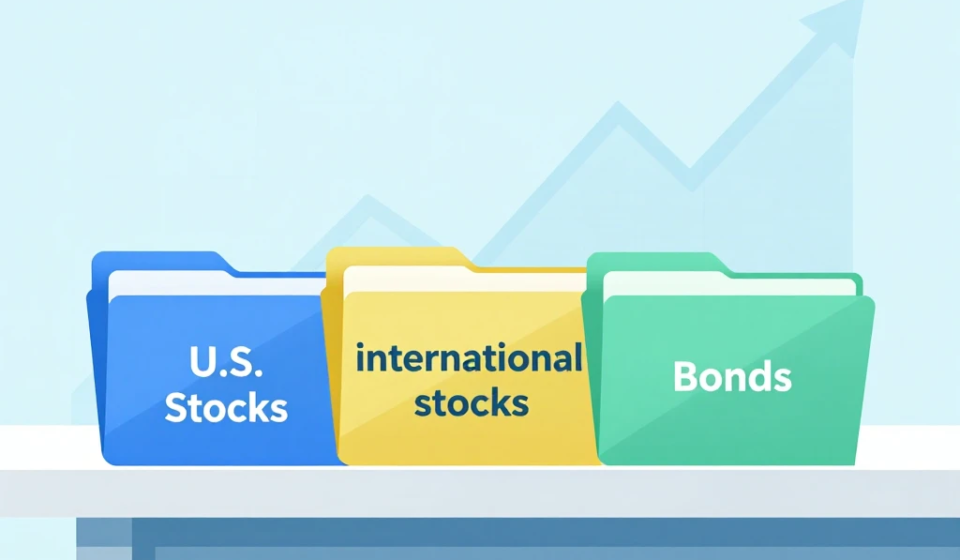
The core idea is straightforward: you hold the entire U.S. stock market, the entire international stock market, and the entire U.S. bond market. Three index funds. You set an allocation based on your age and risk tolerance, contribute regularly, rebalance once or twice a year, and let compounding do the rest.
That’s it. It avoids stock picking, skips sector bets, and ignores predictions about whether small-cap value will outperform large-cap growth this year.
The specific funds most people use in the U.S. are Vanguard’s Total Stock Market Index Fund (VTSAX or VTI), Total International Stock Index Fund (VTIAX or VXUS), and Total Bond Market Index Fund (VBTLX or BND). In the UK, the equivalent approach runs through Vanguard Life Strategy funds or building a similar three-way split through a Stocks and Shares ISA. Canadian investors use similar index funds through TFSA or RRSP accounts, often with a home-country tilt toward Canadian equities.
The funds differ by provider, but the logic is identical: own everything, pay almost nothing in fees, and let markets do what markets do over time.
Why Simplicity Isn’t the Same as Laziness
Here’s where most investors get it wrong. They interpret simplicity as a lack of conviction. They think sophisticated investing means complexity — that more moving parts signals more expertise, more edge, more upside.
The opposite is closer to the truth.
Every additional fund you add introduces correlation assumptions, rebalancing friction, and the temptation to tinker when one position underperforms. Fund managers who try to beat broad market indexes fail to do so consistently, net of fees, over fifteen-year periods. That’s not a controversial claim; it’s the conclusion of SPIVA reports published by S&P Global, which track active fund performance against their benchmarks over time. The numbers don’t flatter active management.
What the three-fund approach does is eliminate the costs of getting things wrong: wrong stock, wrong sector, wrong timing.When you own every company, mistakes in individual fundamentals don’t matter. By holding all markets, international rallies aren’t missed either. That leaves allocation as the main decision—and it’s far easier to adjust.
The Allocation Question Is the Actual Work
If anyone tells you that running a three-fund portfolio requires no thought, they’re glossing over the only part that genuinely matters: how you split it.
A common starting point is the “110 minus your age” rule for equities — meaning a 35-year-old might hold 75% in stocks (split between U.S. and international) and 25% in bonds. This is a rough heuristic, not a prescription. Your income stability, mortgage obligations, emergency fund, and actual psychological tolerance for watching your portfolio fall 30% in a bad year all matter more than your age.
The U.S. versus international split is where reasonable people legitimately disagree. U.S. stocks have dominated international markets for most of the past fifteen years, which has led many American investors to question why they hold international exposure at all. The honest answer is that nobody knows which geography will lead in the next decade. Markets mean-revert. The same investors who argued against international exposure in 2010 because U.S. markets were stronger would have said the opposite thing in 2000, when a decade of U.S. underperformance had just ended. A rough 60/40 or 70/30 U.S.-to-international split is defensible without requiring a view on currency risk or geopolitical timing.
Bonds are the most misunderstood piece. They’re not there to generate returns; they’re there to reduce portfolio volatility, give you something to rebalance from when stocks fall, and dampen the psychological damage of a market crash. A younger investor with a 30-year time horizon and stable employment might reasonably hold 10% to 15% in bonds. Someone five years from retirement needs a different conversation entirely.
When This Strategy Underperforms — and Why That’s Fine
The three-fund portfolio will underperform in specific conditions, and you should know what those conditions are before you commit to it.
In some years, a narrow group of stocks dominates market returns. This happened during the technology surge from 2017 to 2021. A total market fund still participates in the rally. The rest of the index also rises alongside it.
A concentrated bet on technology would have outperformed. That’s real, and investors who made that bet made real money. The history of concentration bets shows a pattern. Investors who outperform during a cycle often hold through the reversal. They give back a large share of their gains. Conviction that worked once becomes a framework applied too broadly.
The three-fund portfolio also trails during emerging market booms, specific commodity cycles, and environments where small-cap stocks meaningfully outpace large-cap. It’s never going to be the best-performing approach in any given year. It is rarely the worst approach. Over 20-year periods, it often ranks in the top quartile of strategies. This is mainly due to low costs.
This is only true if you don’t interfere with it. An investor who holds three index funds but sells them every time markets drop 15% is not running a three-fund strategy. They’re running a market-timing strategy with index funds as the vehicle, which is a different and worse thing.
The Myth of Constant Optimization
There’s a category of investor who is perpetually researching. They’re always reading about factor investing, dividend growth strategies, REIT allocations, covered call overlays, and gold as a hedge. Their portfolio has twenty positions.They spend more time managing it than anything else in their financial life. Their net returns are not meaningfully better than index averages. This is after taxes from frequent rebalancing. It is also after the drag from chasing recent performance.
This isn’t a knock on research. Understanding what you own is valuable. The problem is confusing activity with results. More transactions, more positions, and more adjustments do not automatically produce better outcomes. In many cases, they produce worse ones, because each decision is an opportunity to be wrong.
The three-fund portfolio’s greatest psychological advantage is that it removes most of the decisions you can make. You set the allocation. You automate contributions. Rebalancing happens only when allocation drifts by a meaningful amount.
Most practitioners use a 5% drift threshold before rebalancing.
That’s two or three decisions per year in most market environments. The rest of the time, you leave it alone.
For people wired to always be doing something with their money, this is genuinely hard. It feels irresponsible. It feels passive in a way that doesn’t match the cultural narrative around investing as an active, skilled practice. That discomfort is worth naming, because it causes otherwise rational investors to add complexity they don’t need.
Tax Placement Matters More Than Most People Think
One area where this strategy requires real attention is asset location — which funds go in which accounts.
In general, bonds generate taxable interest income. International funds generate foreign tax credits, which are only useful in taxable accounts. U.S. total stock market funds are among the most tax-efficient vehicles available.
The practical implication is simple. Most investors should hold bonds in tax-advantaged accounts like 401(k), IRA, ISA, or RRSP. They should keep international funds in taxable brokerage accounts where the foreign tax credit can be claimed.
This isn’t complicated, but it’s also not nothing. An investor who holds their entire bond allocation in a taxable account while keeping equity funds in their IRA is paying unnecessary taxes on bond income. Over 20 years, the difference compounds in a way that erodes a meaningful portion of returns.
Tax rules vary meaningfully by country, and the specific vehicles available — Roth IRA versus traditional IRA in the U.S., ISA versus SIPP in the UK, TFSA versus RRSP in Canada — have different implications for where to put which asset class. Getting this right once at the start saves thousands of dollars or pounds over an investing lifetime. It’s worth either doing the research carefully or consulting a fee-only financial adviser for one session specifically on account structure.
The Real Cost of Waiting to Simplify
A lot of investors know, in some part of themselves, that they’d be better off with something simpler.They don’t switch because unwinding a complex portfolio has tax implications. They also believe the more complicated approach will eventually work. Sometimes, simplicity feels like an admission that past effort was wasted.
The sunk cost logic is understandable but expensive. Markets don’t care what you paid for something or how long you’ve held a complicated strategy. The question is always forward-looking: given what you hold now, what gives you the best expected outcome over the remaining investment horizon?
For most individual investors, the three-fund portfolio is enough. Nothing in markets is guaranteed. It works because it removes common mistakes. These include high fees, excessive trading, emotional decisions, and poor diversification.
What to Check, What to Avoid, and What to Decide Next
Before implementing this approach, ensure your emergency fund is separate and highly liquid. Keep at least three to six months of expenses in a safe, non-market account. Index funds are for long-term investing. Without a liquidity buffer, investors may be forced to sell at the worst possible time.
Check the expense ratios on whatever funds you’re considering. Vanguard’s index funds charge 0.03% to 0.07% per year in most cases. Anything above 0.20% for a broad index fund should prompt a question about whether a lower-cost alternative is available in your country or account type.
Avoid the temptation to add satellite positions “just to juice returns a little.” This is how three-fund portfolios turn into twelve-fund portfolios over five years. If you want to hold a small-cap tilt or a REIT allocation, that’s a defensible choice — but make it deliberately, understand what you’re adding and why, and hold it through underperformance.
The decision to make next is simpler than most people expect: pick a provider, calculate your target allocation, automate contributions, and set a calendar reminder to review it twice a year. The entire setup, for most investors, takes less than two hours. The results, held consistently over decades, tend to speak for themselves.
Frequently Asked Questions
Do I really need international exposure, or can I just hold U.S. stocks?
You can, and many U.S. investors have done well holding only domestic equities. The argument for international exposure isn’t that it always outperforms, but that it removes a concentrated country bet from your portfolio. U.S. markets represent roughly 60% of global market capitalization, but that ratio shifts over time. Holding international funds means you’re not dependent on U.S. markets specifically to deliver the returns your retirement requires. For UK and Canadian investors, this also means not being overweight a smaller domestic market.
At what point should I add more funds or complexity?
This only makes sense when you have a specific, evidence-based reason to expect a persistent return premium. It also requires the ability to hold through years of underperformance. Factor investing, such as tilting toward value, small-cap, or profitability, has academic support. But it demands more patience than most investors expect.
Adding complexity because you’re bored or because something has recently performed well is almost never a good reason.
How often should I rebalance?
Most evidence suggests annual rebalancing or threshold-based rebalancing (rebalancing when an asset class drifts more than 5% from its target) produces similar outcomes. There’s no meaningful advantage to rebalancing more frequently, and more frequent rebalancing in taxable accounts creates unnecessary tax events. Set a rule and stick to it rather than evaluating continuously.
What if I’m already close to retirement?
The three-fund structure still works, but the allocation shifts substantially. Sequence-of-returns risk — the danger of experiencing major market losses early in your withdrawal phase — means retirees and near-retirees typically need a higher bond allocation than a simplified age rule suggests. Someone five years from retirement might reasonably hold 30% to 40% in bonds, even if that feels conservative in a period of rising equity markets. A fee-only adviser review is worth the cost at this stage.
Is this approach different in the UK or Canada?
The structure is the same; the vehicles differ. UK investors typically use Vanguard LifeStrategy funds inside an ISA, or build a three-fund equivalent with FTSE All-World, UK gilts, and an ex-UK international fund. Canadian investors often hold XEQT or VEQT as all-in-one equity solutions, adding a bond ETF for ballast. The core principle — own the whole market, pay minimal fees, hold for the long term — translates across all three countries without modification.
What happens to this strategy during a recession?
It falls. A portfolio with 80% equities will drop significantly during a recession; the 2008 financial crisis produced drawdowns of 40% to 50% for diversified equity investors. The question isn’t whether the three-fund portfolio declines in recessions — it will — but what you do when it does. Investors who held through 2008 and continued contributing saw their portfolios recover and surpass prior highs within five years. Investors who sold at the bottom locked in losses permanently. The strategy works or fails almost entirely based on investor behavior, not the index itself.



[…] The 3-Fund Portfolio Strategy That Builds Wealth Automatically […]
[…] employer may not translate to external clients. A property in a low-demand rental market may not generate yield worth the management effort. The asset has to match the market, not just […]